Showing posts with label AncestryDNA. Show all posts

19 April 2017

National DNA Day Sales 2017

National DNA Day is coming soon—25 April. Sales on DNA kits have already started!

Updates added 21 April 2017.


Family Tree DNA (FTDNA) starts their sale on April 20, ending at 11:59 p.m. Central Time on Thursday, 27 April.

Upgrades on prior Y-DNA and mtDNA tests are not included. Adding a new test to an existing kit will receive the discounted sale price. See all of the current sale prices on this product page once the sale starts. To add a test to an existing kit, login to the account first. To order a new kit for someone without an account, just click on the price button on the product page and follow the instructions on the screen.

If you are attending the New England Regional Genealogical Consortium conference at MassMutual Center in Springfield, Massachusetts on 26-29 April, the FTDNA crew will be in attendance. Kits can be purchased at special event prices at the conference until the Exhibit Hall closes on Saturday. The Exhibit Hall will be open to the public at no charge 9:00 a.m. to 5:00 p.m. local time on Thursday; 9:00 a.m. to 5:00 p.m. on Friday; 9:00 a.m. to 4:00 p.m. on Saturday.


AncestryDNA is offering 20% off—sale price is $79 for the autosomal DNA test. Be aware that if you do not pay a subscripton fee to Ancestry you do not have access to all features (see https://support.ancestry.com/s/article/ka215000000TzydAAC/Accounts-after-Cancellation). When viewed on 21 April 2017, this page indicates that with a guest account you can see ethnicity estimates, DNA matches, Genetic Communities, automatic updates to your ethnicity estimate as updates are released, shared matches, and you can contact matches; you do not have access to New Ancestry Discoveries, DNA Circles, Shared Ancestor Hints, viewing your matches’ trees, or lists of surnames and birth locations that appear both your tree and your matches’ trees.


MyHeritage is offering autosomal DNA tests for $79.


LivingDNA is offering $40 off their test for a sale price of $119. LivingDNA's test is different than what we have been using for DNA and there is no match list (so far). See Roberta Estes' blog post describing her LivingDNA test results for more info.


23andMe has no special listed on their website as of 21 April 2017, 4:30 p.m. CDT.


Have fun analyzing the shared DNA segments and determining how you are related to all of your DNA matches!

If you need to learn more about how to analyze your DNA matches check out our genetic genealogy workbook Genetic Genealogy in Practice, co-written by me and Blaine T. Bettinger.


To cite this blog post: Debbie Parker Wayne, "National DNA Day Sales 2017," Deb's Delvings, 19 April 2017 (http://debsdelvings.blogspot.com/ : accessed [date]).

© 2017, Debbie Parker Wayne, Certified Genealogist®, All Rights Reserved

01 April 2017

AncestryDNA Genetic Communities

Note: All images are screenshots captured by Debbie Parker Wayne. Where names of living people are include, permission was obtained.

Be aware: Genetic Communities is clearly marked as a "beta" resource. It will change over time and changes have already been seen in the community makeup, names, and assignments since the rollout.

This week AncestryDNA unveiled a new tool for DNA test-takers—Genetic Communities. This tool may clear up some of the widespread misunderstanding of admixture prediction. Admixture predictions are based on where our ancestors may have been thousands of years ago—a period for which few genealogists have documentary evidence. Genetic communities are where our ancestors were within two hundred years (more or less)—a period for which most genealogists have documentary evidence.

Quick! Take advantage of the chance to learn about Genetic Communities for free through until 6 April 2017 by viewing this informative webinar recording. There is a fee to view after that date.

Blaine T. Bettinger, "Exploring AncestryDNA's New Genetic Communities," webinars, Legacy Family Tree (http://familytreewebinars.com/download.php?webinar_id=618).

On March 20th on Facebook Blaine asked each of us to predict what our Genetic Communities (GC) would be. My prediction was Upper South and Lower South:


This prediction is based on the birth states of my ancestors shown in the chart below. A Facebook friend started a meme a year or so ago. He had us creating four to six generation pedigree charts listing only the birthplaces of ancestors and color-coding the blocks. Here is the chart I posted last year (I have filled in a few of the question marks since then with ancestor names). It shows all of my ancestors born in the South back to the early 1800s. Earlier generations are not shown here, but they are in the southern United States as far back as I have traced each line. I have one lone fourth-great-grandfather who was supposedly born in New York in about 1800 and was in Mississippi by 1810 to 1820.


My GCs are exactly what I predicted. The names assigned by Ancestry are not Upper South and Lower South. The expected Southern states are included in the GCs which have been given more descriptive names by AncestryDNA.


So how do these GCs help me with my genealogical research? For me, I get few new clues as to locations of ancestors after the late 1700s. Someone with a less extensive tree may get clues as to which states their ancestors came from.

Clicking the Connections button, I do get some clues as to potential European origins of most settlers in the areas where my ancestors settled in the New World. These clues agree with the family stories that have been passed down of ancestral origins in Germany, England, Scotland, and Ireland.


I see a list of surnames that are found more often in this GC than outside of it. I can use the "View All Matches" button to see which of my DNA matches are also part of this GC.


This match list contains only DNA matches who are also part of this GC. A match with a shallow tree may be able to get some clues from the ancestors in my tree that are in this GC.


Back on the window with the GC Stories, if I click on one Year Span in the community story bar I can see which of my ancestors were in this community during that time span. I can use the left and right arrow keys next to the year span to cycle through all year spans.


I can zoom the map in to see finer detail. I can click on a "pin" on the map to see which ancestors are associated with this pin.


As of now, all of my ancestor pins only narrow the locale down to a region of a state. This may be because my tree on Ancestry does not include county level details for all events. However, if Ancestry plans to extend this GC tool to show us our ancestors and ancestors of our matches in the same or nearby counties, I may be tempted to share more of the details in my tree on Ancestry. (I never had a tree on Ancestry.com until I took a DNA test with them and wanted to use some of the DNA tools that require a public tree. I only took the time to enter a barebones tree with ancestors; no collaterals; basic birth, marriage, death info; and states only for some locations. At least once RootsMagic can sync with Ancestry it will be easier to update an Ancestry tree if I decide to place all of my data online.)

It is helpful to see which of my ancestral lines were in the same or nearby counties at the same time. This is a great by-product of the GC maps. Before now, I had to use other tools to map where my ancestors were at any given time.

For details on the science behind Genetic Communities and how others have used GCs see these resources.

The scientific paper:
Eunjung Han, et al., "Clustering of 770,000 genomes reveals post-colonial population structure of North America," Nature Communications 8, Article number: 14238 (2017) doi:10.1038/ncomms14238 (http://www.nature.com/articles/ncomms14238).

The Ancestry white paper:
Catherine A. Ball, et al., "Genetic Communities™ White Paper: Predicting fine-scale ancestral origins from the genetic sharing patterns among millions of individuals," Ancestry (https://www.ancestry.com/cs/dna-help/communities/whitepaper).

Blaine Bettinger, "AncestryDNA’s Genetic Communities are Finally Here!," The Genetic Genealogist, 28 March 2017 (http://thegeneticgenealogist.com/2017/03/28/ancestrydnas-genetic-communities-are-finally-here/).

Leah LaPerle Larkin, "Genetic Communities Are Here!," The DNA Geek, 27 March 2017 (http://thednageek.com/genetic-communities-are-here/).

Leah LaPerle Larkin, "The Science Behind Genetic Communities at AncestryDNA," The DNA Geek, 3 March 2017 (http://thednageek.com/the-science-behind-genetic-communities-at-ancestrydna/).

Roberta Estes, "More About Genetic Communities and Display Problem Hints," DNAeXplained – Genetic Genealogy blog, 28 March 2017 (https://dna-explained.com/2017/03/28/more-about-genetic-communities-and-display-problem-hints/).


To cite this blog post: Debbie Parker Wayne, "AncestryDNA Genetic Communities," Deb's Delvings, 1 April 2017 (http://debsdelvings.blogspot.com/ : accessed [date]).

© 2017, Debbie Parker Wayne, Certified Genealogist®, All Rights Reserved

21 April 2016

DNA Sales and Presentations for DNA Day Celebrations

Yes, there is an official National DNA Day! April 25th.


This year the U.S. National Human Genome Research Institute (NHGRI) is presenting an online lecture on "Harry Potter and the Genetics of Wizarding." See more at https://www.genome.gov/10506367/national-dna-day/.

In Tyler, Texas, we will celebrate early on April 23 with an all-day DNA seminar to teach genealogists to begin analyzing DNA test results for evidence to apply to genealogical questions. See more at http://debsdelvings.blogspot.com/2016/04/hands-on-dna-workshop-april-23-tyler.html and http://etgs.org/meetings/etgsmtg04_a.html.


Both AncestryDNA and Family Tree DNA are offering sales on DNA test kits.

AncestryDNA is offering a $20 discount — $79 plus free shipping if you use the FREESHIPDNA code. Offer ends Tuesday, 26 April 2016 at 11:59 p.m. ET.

Testing at AncestryDNA allows easy comparisons between your public family tree on Ancestry, if you have one, and the public tree of your DNA matches, if they have a public tree. In-depth analysis of shared DNA segments will require the test results (the raw data file) be uploaded to a third-party tool such as GEDmatch.com. AncestryDNA does not provide the in-depth analysis tools most genetic genealogists need and want. AncestryDNA uses a saliva sample.

Family Tree DNA is offering a $20 discount — $79 for the autosomal DNA test called Family Finder PLUS discounts on most other Y-DNA and mtDNA tests. Offer ends Tuesday, 26 April 2016 at 11:59 p.m. ET.

The Family FInder test and AncestryDNA test are very similar, but only Family Tree DNA offers Y-DNA and mtDNA tests which can be done using the same DNA sample. Family Tree DNA uses a cheek swab which can be easier for some elderly relatives.

Testing at Family Tree DNA allows comparisons between your public family tree on Family Tree DNA, if you have one, and the public tree of your DNA matches, if they have a public tree. In-depth analysis of shared DNA segments can be done using the In-Common-With, Matrix, and chromosome browser tools provided by Family Tree DNA. In addition to using the company-provided tools, the raw data file can also be uploaded to a third-party tool such as GEDmatch.com. The shared segment data can be downloaded using third-party tools at DNAgedcom.com. That data can then be used in many other tools such as Genome Mate Pro and other Genetic Genealogy Tools.

Family Tree DNA's announcement includes this info and these prices for other DNA tests:
The prices are below, and are valid on new tests and add-ons only. Discounts do not combine with existing group discounts. Upgrades will be discounted in June.

Product — Retail Pricing — Sale Price

Family Finder — $99$79
mtFull Seq — $199$149
Y37 — $169$129
Y67 — $268$199
Y111 — $359$289
BigY — $575$460
SNP Packs — $119$109
mtDNA plus — Not on Sale

Let's celebrate DNA Day by adding thousands of test results to the databases!


To cite this blog post:
Debbie Parker Wayne, "DNA Sales and Presentations for DNA Day Celebrations," Deb's Delvings Blog, posted 21 April 2016 (http://debsdelvings.blogspot.com/ : accessed [date]).


© 2016, Debbie Parker Wayne, Certified Genealogist®, All Rights Reserved

03 January 2015

Which DNA test should I take?

Which DNA test should I take? Is it worthwhile? What will I learn?

I see these and similar questions asked dozens of times a day on mail lists, forums, and social media sites. Some people recommend what worked for them, but what was "best" for us may not be best for the person asking today.


Chart of one person's number of Family Finder matches at Family Tree DNA over several years.

A DNA test is the genealogical resource that keeps on giving: as more people test you will get more matches. After taking a DNA test you need to periodically look at data for your new matches. You never know when the person whose DNA can solve your hardest genealogical problem will take a DNA test.

Knowing how DNA test results could contribute evidence to answer your genealogical question is critical to knowing which test to take and where. So here are some specific questions with the answer I would give today. As companies change their lab procedures, sequencing techniques, databases, tool offerings, customer service, and we learn more about DNA, these answers might change. As new companies are formed, these answers might change.

The three biggest genetic genealogy testing companies include Family Tree DNA, 23andMe, and AncestryDNA. For anthropological testing that may also be applied to genealogical research there is the National Geographic Genographic Project.

Many other companies also offer specialty testing and analysis services for those unable to do the analysis themselves. The "big three" will be the primary focus of this article. For the tests that are offered by all three companies, the base price of the tests is the same, although sale prices can provide significant savings. To find out about sales read the posts of genetic genealogists on blogs, Facebook, mail lists, and forums.


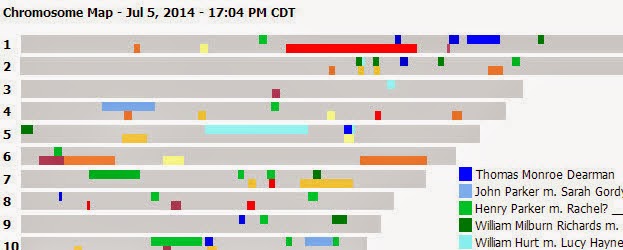
Debbie Parker Wayne, Partial Display of Mapped Chromosome Segments, 5 July 2014, created with Chromosome Mapping Tool by Kitty Cooper (http://kittymunson.com/dna/ChromosomeMapper.php : accessed 5 July 2014).

Is it worthwhile to take a DNA test for genealogy?
Yes, unequivocally for most of us.

For yourself, how much you will learn depends on how much effort you are willing to put in to learning how to use DNA evidence. For more information see Debbie Parker Wayne, "Disappointed in DNA test results?," Deb's Delvings Blog, posted 16 September 2013 (http://debsdelvings.blogspot.com/2013/09/disappointed-in-dna-test-results.html : accessed 3 January 2015). There are hundreds of blogs posts out there from dozens of genetic genealogists on how to use DNA test results.

For others, your DNA and family tree may provide the match needed to break down a long standing brick wall. Or for someone who has no knowledge of her biological parents to connect to family.

For the future, one of the best reasons to take a DNA test is to "bank" your DNA or the DNA of elderly relatives for future testing. As much as we know today about DNA, more will be known in the future. Our grandkids and great-grandkids may learn more from our DNA than we will be able to learn.

Today, Family Tree DNA advertises DNA samples will be stored to allow for testing in the future. Other companies may store leftover biological material, but they do not allow additional tests to be ordered at this time. No company can guarantee there will be enough stored material or viable DNA material for a particular test. But if the material is not stored and made available then there is NO chance of testing once a relative is deceased.

Is one company more economical than the others?
See Judy G. Russell, "2014: Most bang for DNA bucks," The Legal Genealogist blog, posted 6 April 2014 (http://www.legalgenealogist.com/blog/2014/04/06/2014-most-bang-for-dna-bucks/ : accessed 3 January 2015).

What will I learn?
A DNA test will provide several types of information: a list of other people in the database of the testing company who have DNA that matches yours and values for the DNA markers tested. Depending on the type of DNA test the markers and values will vary. For some test types, the companies provide an ethnicity prediction based on comparison to the population database used by the testing company.

Notice use of the phrase "the testing company" above. This means you may get different lists of people with matching DNA at each company because different people tested at each company and different ethnicity predictions because each company uses a different population database. This is why testing at all three companies is recommended. More on test types, databases, and ethnicity predictions below.

What kinds of tests are offered for genetic genealogy?
Y-DNA tests have been offered for about fifteen years now. Only men have Y-DNA; Y-DNA is passed from father to son. You can only learn about the direct patrilineal line of the man tested, and Y-DNA can be traced back many generations.

Mitochondrial DNA (mtDNA) tests have also been offered for about fifteen years now. Both men and women have mtDNA; mtDNA is passed from mother to all children; only daughters pass mtDNA to the next generation. You can only learn about the direct matrilineal line of the person tested, and mtDNA can be traced back many generations.

Autosomal DNA (atDNA) tests have been widely available for over five years now. Both men and women have atDNA; atDNA is passed from both parents, they inherited it from both of their parents, and so on. You can learn about every line on the pedigree chart of the person tested, but atDNA can only be traced back easily and reliably a limited number of generations. As you go back more generations it generally gets more difficult to use atDNA for genealogical evidence.

What can you learn from a Y-DNA test?
See Debbie Parker Wayne, "Using Y-DNA for Genealogy," National Genealogical Society, NGS Magazine 40 (January-March 2014): 20-24; PDF online (http://debbiewayne.com/pubs/pub_NGSMag_201311_Y-DNA_ALL.pdf : accessed 3 January 2015).

What can you learn from an mtDNA test?
See Debbie Parker Wayne, "Using mitochondrial DNA for Genealogy," National Genealogical Society, NGS Magazine 39 (October-December 2013): 26-30; PDF online (http://debbiewayne.com/pubs/pub_NGSMag_201308_mtDNA_ALL.pdf : accessed 3 January 2015).

What can you learn from an atDNA test?
See Debbie Parker Wayne, "Using autosomal DNA for Genealogy," National Genealogical Society, NGS Magazine 40 (April-June 2014), 50-54; PDF online (http://debbiewayne.com/pubs/pub_NGSMag_201402_atDNA_ALL.pdf : accessed 3 January 2015)
and
Debbie Parker Wayne, "Using X-DNA for Genealogy," National Genealogical Society, NGS Magazine 40 (July-September 2014): 57-61; PDF online (http://debbiewayne.com/pubs/pub_NGSMag_201405_X-DNA_ALL.pdf : accessed 3 January 2015).

Which company should I test with ... if I am interested in testing myself and I have no specific goal in mind? I just think DNA testing is cool and I want to do it.
Take an autosomal DNA test with all three of the "big" genetic genealogy testing companies. If you also want to contribute to anthropological discoveries for the human race test at National Geographic Genographic Project.

This can be accomplished by ordering individual tests from each company or by testing separately at 23andMe and AncestryDNA then transferring results from AncestryDNA to Family Tree DNA. Family Tree DNA does the lab work for National Geographic so results from the Genographic Project can be transferred to the Family Tree DNA database then additional tests can be ordered using the same DNA sample provided for National Geographic.

The only test offered by three of the companies is primarily an autosomal test so you don't have to know a specific name for the test. Family Tree DNA offers other tests so you must order a "Family Finder" test to get the autosomal DNA test there.

Does my ethnicity affect which company I should test with?
It depends.

Some factors to consider include (statements based on my personal experience and statements made by other genetic genealogists that I trust, your experience may vary):
  • African American ancestry: 23andMe actively recruited African and African American testers so have a significant number of testers in their database. AncestryDNA, by providing access to many family trees and documents, can make it easier to see patterns that can link slaveholders and ancestors who were held in slavery. Family Tree DNA uses a higher threshold that seems to result in fewer DNA matches for many African American researchers.
  • American Colonial ancestry: AncestryDNA's database includes more testers with deep colonial American ancestry, but all of the testing companies cover many in this category.
  • Ashkenazi Jewish ancestry, and others where small populations intermarried: These intermarriages result in a lot of small shared DNA segments that confuse the algorithms into predicting a closer relationship between two testers. Family Tree DNA has a lot of expertise in this area for those with Ashkenazi Jewish ancestry. AncestryDNA modified their match algorithm recently and may get better in this area. 23andMe limits the number of matches seen by a tester so some relatives may not be seen in the DNA match list.
  • Native American: Where Native American ancestry is suspected on the direct patrilineal line a Y-DNA test gives conclusive results. Where Native American ancestry is suspected on the direct matrilineal line an mtDNA test gives conclusive results. Where Native American ancestry is suspected on other lines, an autosomal DNA may or may not provide evidence.

    If the Native American ancestor is within five or so generations of a tester, it is likely to be detected. If it is more generations to the Native American ancestor, or random recombination of DNA resulted in the tester not having a detectable amount of DNA from that particular ancestor, Native American ancestry may not be detected even though it exists in the lineage. Testing other cousins in this line may result in detectable amounts of Native American DNA.

    23andMe uses an algorithm that seems to detect small amounts of Native American DNA not reported by the other companies
  • Old World lineage (not North or South American): Today, 23andMe and Family Tree DNA have more testers in their databases from outside of the Americas. AncestryDNA is about to offer testing outside of the USA so their database of testers from other locales may grow soon.

Will I learn about health related issues from a genetic genealogy test?
If you are interested in learning health related information, testing at 23andMe or AncestryDNA will provide more medically-significant markers. The data from the testing company can be analyzed by Promethease or other third-party tools. At some point in the future, 23andMe may again provide links to the medically significant information without the need for a third-party tool.

Which testing company is easiest? I don't have time to learn how to analyze DNA.
Testing at AncestryDNA may be the easiest for those who are not willing to invest time in learning how to use DNA results effectively for genealogical research. A public tree on Ancestry helps to get the most from a DNA test taken at Ancestry.

AncestryDNA does not provide the detailed segment data needed to make use of the most popular DNA analysis tools. Those who have tested at AncestryDNA and want to do detailed analysis must upload the raw DNA data to a third-party website (such as GEDmatch) or use third-party utilities (of which there are many). Comparisons can only be done with others who have also uploaded to the same site.

You can learn SO MUCH MORE from your DNA tests if you are willing to invest some time in learning how DNA answers genealogical questions. The image above labeled "Partial Display of Mapped Chromosome Segments" shows how some are mapping particular segments of chromosomes to specific ancestors using detailed DNA analysis and tools written by genetic genealogists with programming skills.


geralt, stress___burnout-231452_1280.jpg, "Burnout Man Psychology Rays Stress Hand Face Old," PixBay (http://pixabay.com/en/burnout-man-psychology-rays-stress-231452/ : accessed 16 July 2014), Public Domain CC0 license.

How do I learn to make effective and detailed use of DNA to answer genealogical questions?
  1. Learn about genetic genealogy and analysis techniques. Places for more information include:
  2. Practice the techniques on your own family data.

Choosing a testing company when you can't afford to test at all three may be affected by the following considerations.

Is support via telephone an important consideration?
Both Family Tree DNA and AncestryDNA provide telephone support, but the knowledge level of the customer service representatives covers a wide spectrum. In my experience and anecdotally, Family Tree DNA excels in both telephone and e-mail support to customers, quickly getting more knowledgeable persons involved if the first rep contacted cannot answer a question.

23andMe offers support online and not via telephone. Their customer support representatives have a reputation for providing knowledgeable and useful answers.

Are you testing an elderly relative who has trouble producing saliva?
Family Tree DNA uses a cheek swab to obtain a DNA sample (the tester rubs the swab on the inside of the cheek, cheek cells collect on the cotton swab). This is easier for many elderly people. As a special request option, 23andMe offers a test kit that requires less saliva than the standard test.

The ways we use DNA and the tools we use will continue to advance and change over the coming years. We will all need to continue our education as those advances come.

** Disclaimer: I coordinate the "Practical Genetic Genealogy" courses offered at GRIP and the "Getting Started with Genetic Genealogy" course offered in 2015 at SLIG. Back in 2010 I started planning topics I thought should be offered in a week-long institute for genetic genealogists. I then searched for the best people to help teach the course and found CeCe Moore and Blaine Bettinger. We had similar ideas about what was needed to bring the genealogy and genetic genealogy communities together. CeCe and Blaine helped refine the session topics based on their experiences. In July 2014 our plans came to fruition with the first "Practical Genetic Genealogy" course offered at GRIP. More and more institutes and conferences are offering more advanced genetic genealogy education.


To cite this blog post:
Debbie Parker Wayne, "Which DNA test should I take?," Deb's Delvings Blog, posted 3 January 2015 (http://debsdelvings.blogspot.com/ : accessed [date]).

© 2015, Debbie Parker Wayne, CG, CGL, All Rights Reserved

25 April 2014

DNA Day 2014

Today is DNA Day—celebrating publication of the structure of DNA and the announcement of "completion" of the mapping of our DNA by the Human Genome Project.1


Big things happening today include the updated Y-DNA Haplotree from Family Tree DNA. The tree is being expanded from 400 to over 1000 branches and will sport a new design interface. A free webinar today at noon Central Time (5pm UTC) will provide details on and demonstrate the new tree. Register for the live webinar at http://bit.ly/1dGbbbx or catch it later when it will be posted online at http://www.familytreedna.com/learn/ftdna/webinars/.

AncestryDNA is offering a $20 discount on their autosomal DNA test.

23andMe isn't advertising a sale today as they did a sale earlier this year. This is another good place for a DNA test for genealogical purposes.

Check the websites of other testing companies to see what they may be offering today. But if you are ordering an autosomal test for genealogical purposes be sure you are getting a test that includes 500,000 markers or more and not one of the lower resolution tests.


1. "DNA Day," WikiPedia (http://en.wikipedia.org/wiki/DNA_day : accessed 25 April 2014)


To cite this blog post:
Debbie Parker Wayne, "DNA Day 2014," Deb's Delvings Blog, posted 25 April 2014 (http://debsdelvings.blogspot.com/ : accessed [date]).

All images created by and © 2014, Debbie Parker Wayne, CG, CGL, All Rights Reserved

© 2014, Debbie Parker Wayne, CG, CGL, All Rights Reserved

18 September 2013

Why So Much Excitement about Ethnicity Predictions?

AncestryDNA made a recent announcement about updates to the ethnicity predictions available with their autosomal DNA (atDNA) test. The first sentence on their web page for ordering a DNA test is:
Discover if you're part Scandinavian, West African, or maybe Native American.1
The first sentence describing a Family Finder atDNA test at Family Tree DNA is:
NEW! Discover close relatives and your ethnic percentages with Family Finder!2
At 23andMe you have to click on the Ancestry link at the top of the home page before you scroll down and see:
Find out what percent of your DNA comes from populations around the world, ranging from East Asia, Sub-Saharan Africa, Europe, and more. Break European ancestry down into distinct regions ...3

I caution people about putting too much faith in these ethnicity and regional predictions for two reasons that still apply even if new advances in our knowledge have been made recently.
  1. Because of DNA recombination you may not have detectable amounts of DNA representing all of the ethnicities or geographies you see in your full pedigree chart.

    Blaine Bettinger described this well in a post several years ago titled, "Q&A: Everyone Has Two Family Trees – A Genealogical Tree and a Genetic Tree."4 While Blaine was answering a question about why a known cousin was not listed on a person's DNA match list, the answer is just as applicable to the question of why a person's predicted ethnicity percentages isn't reflected in the known pedigree of that person. Each of us inherits only one-half of the DNA of each parent. This also means about one-half of each parent's DNA is lost in each generation except where some bits are inherited by one offspring and not others. As we go back more generations we have inherited less DNA from those ancestors.
  2. The world population is about seven billion today.5 At most, a few hundred thousand people have taken genealogical DNA tests.6 This means that fewer than one/ten-thousandth of the world has been tested. That is a very small sample size.

    As more people test we will learn more about accurate interpretation of the DNA data. We are still in the infancy of this new science. I highly encourage researchers to test so we can learn more faster. You will learn some interesting information about your DNA. But I caution against making life-altering decisions based on today's technology and knowledge level, even with the recent updates.

For an interesting map showing how the boundaries of Europe have changed over the years take a look at this map (thanks to Debbie Kennett for sending the link to several DNA mail lists):

http://www.liveleak.com/view?i=14d_13483626927

Now think about how those changes make it difficult to relate a segment of DNA to a particular country. I have to admit that I was surprised at the constantly changing European landscape even though I have always been interested in and constantly read about history. Anyone who does not understand human migrations, how those migrations don't really coincide with political boundaries, and how our DNA makeup is not a reflection of our entire pedigree due to random recombination, could have a difficult time understanding their ethnicity predictions based on DNA.


For more information on ethnicity predictions also known as Bio-Geographical Analysis (BGA) see:

Dr. Doug McDonald (the developer of one of the early programs for Bio-Geographical Analysis), "Doug McDonald on Biogeograpical Analysis," 9 September 2012 guest post, DNAeXplained – Genetic Genealogy blog of Roberta Estes (http://dna-explained.com/2012/09/09/doug-mcdonald-on-biogeograpical-analysis/).


For more information on the updated AncestryDNA ethnicity predictions see these articles and the links within them to other articles:

Blaine Bettinger, PhD, JD, "AncestryDNA Launches New Ethnicity Estimate," 12 September 2013, The Genetic Genealogist (http://www.thegeneticgenealogist.com/2013/09/12/ancestrydna-launches-new-ethnicity-estimate/).

Debbie Kennett, "My updated ethnicity results from AncestryDNA - a British perspective," 17 September 2013, Cruwys news (http://cruwys.blogspot.com/2013/09/my-updated-ethnicity-results-from.html).

Judy G. Russell, JD, CG, "DNA disappointment," 15 September 2013, The Legal Genealogist, (http://www.legalgenealogist.com/blog/2013/09/15/dna-disappointment/).

Randy Seaver, "First Look at my AncestryDNA Ethnicity Update - Post 2: More DNA Results," 13 September 2013, Genea-Musings, (http://www.geneamusings.com/2013/09/first-look-at-my-ancestrydna-ethnicity_13.html).


All URLs accessed 18 September 2013.

1. "One simple DNA test. A world of discoveries," AncestryDNA (http://ancestrydna.com/).

2. "Family Finder," Family Tree DNA (http://www.familytreedna.com/family-finder-compare.aspx).

3. "Your story begins as far back as you can imagine," Ancestry page, 23andMe (https://www.23andme.com/ancestry/).

4. Blaine Bettinger, PhD, JD, "Q&A: Everyone Has Two Family Trees – A Genealogical Tree and a Genetic Tree," 10 October 2009, The Genetic Genealogist (http://www.thegeneticgenealogist.com/2009/11/10/qa-everyone-has-two-family-trees-a-genealogical-tree-and-a-genetic-tree/).

5. Haya El Nasser, "World population hits 7 billion," 31 October 2011, USA TODAY (http://usatoday30.usatoday.com/news/world/story/2011-10-30/world-population-hits-seven-billion/51007670/1).

6. "Autosomal DNA testing comparison chart," ISOGG Wiki, International Society of Genetic Genealogists (http://www.isogg.org/wiki/Autosomal_DNA_testing_comparison_chart); gives an estimate as of August 2013 of 640,000 people in the autosomal databases of 23andMe, Family Tree DNA, AncestryDNA, and National Geographic Genographic Project Geno 2.0.

7. pierre_mesyne, "abkebab's Map of Europe 1000 AD to present with timeline," LiveLeak (http://www.liveleak.com/view?i=14d_1348362692).


To cite this blog post:
Debbie Parker Wayne, "Why So Much Excitement about Ethnicity Predictions?," Deb's Delvings Blog, posted 18 September 2013 (http://debsdelvings.blogspot.com/ : accessed [date]).

© 2013, Debbie Parker Wayne, CG, CGL, All Rights Reserved

22 July 2013

July 27, Free DNA Seminar at Houston's Clayton Library (Reminder)

Just a Reminder:

If you are in the Houston area this weekend please join me for a free all-day seminar on genetic genealogy at Clayton Library Center for Genealogical Research. These sessions will cover basic genetics for beginners and an introduction to analyzing your DNA test results. A detailed handout includes instructions that go beyond the steps we'll have time to cover in the seminar.

Registration will begin in the Carriage House shortly after the library opens at 10:00 a.m. The sessions include:

  • 10:30-12:00 GATA GACC! DNA and Genetic Genealogy Today—Learn where we are today using DNA for genealogy. Maximize Y-DNA, mitochondrial DNA, and autosomal DNA test results to contribute to genealogical research goals.
  • break for lunch on your own
  • 1:30-2:15 Going Nuclear: DNA Discoveries to Trace All Lines of Descent—Learn to link families using autosomal DNA test results from any testing company. Maximize impact on your genealogical research goals. Includes how to use test results such as those from 23andMe, Family Tree DNA, and AncestryDNA.
  • 2:30-3:15 Paternal Lines: Using Y-DNA—Learn details of Y-DNA testing including how to analyze test results. Findings can corroborate your paper trail or place you on the right research path.
  • 3:30-4:15 Maternal Lines: Using Mitochondrial DNA (mtDNA)—Understand mitochondrial DNA testing with an introduction to analysis of test results. Sample research problems demonstrate how mtDNA can be used by genealogists.

To register for the classes, please call 832-393-2600. All classes are free and open to the public, but space is limited.

Directions to the library can be found here.


To cite this blog post:
Debbie Parker Wayne, "July 27, Free DNA Seminar at Houston's Clayton Library (Reminder)," Deb's Delvings Blog, posted 22 July 2013 (http://debsdelvings.blogspot.com/ : accessed [date]).

© 2013, Debbie Parker Wayne, CG, CGL, All Rights Reserved

25 August 2012

The Informed DNA Tester

Disclaimer: The following represents my opinions. I've spoken and written little publicly about the issue of Ancestry.com not providing raw DNA data to their genetic genealogy customers, here, in several posts on mail lists, in DNA presentations, and in private messages. I try to be fair when stating my objections to policies and actions of a company whose product I use every day. I don't use their DNA products or put family trees on their site. I make extensive use of their databases and record images. I analyze DNA data from Ancestry for clients and family members and compare it to the results from other companies when enough information is provided to allow this. I pay standard subscription rates for all services from Ancestry. I do not receive free access or services from them or from any other DNA company.

I believe it is important to test with a company that gives you full access to your DNA data. The graphical tools provided by the testing companies allow only the most superficial analysis of the data. The raw DNA data can be used in many utilities and by knowledgeable genetic genealogists to help you learn more about your family history. Isn't that the main reason you took the DNA test?

Ancestry.com, under the name AncestryDNA, offers genetic genealogy tests. Even though their policy states you own your data, they do not provide the raw data results to you. Having access to the raw data is important, not only because it is your data and you can learn more by analyzing the raw data. When an error occurs, as is possible in any human endeavor, the error can be caught quickly when we see the actual data. When all we see is a graphical representation of that data, as interpreted by a proprietary algorithm, it is difficult to determine the cause of an unexpected result. The genetic genealogy community has helped quickly resolve problems in the past by analyzing the raw DNA data and seeing illogical results.

In my opinion, every customer of Ancestry should demand the raw DNA data be made available to them. For details of a specific problem that brings this point home, see these blog posts:
CeCe Moore, "AncestryDNA: Confusing Relationship Predictions and Adoptees," Your Genetic Genealogist blog, posted 21 August 2012 (http://www.yourgeneticgenealogist.com/2012/08/ancestrydna-confusing-relationship.html : accessed 21 August 2012).

CeCe Moore, "Follow Up: Lab Error Responsible for Adoptee's Confusing Match at AncestryDNA," Your Genetic Genealogist blog, posted 24 August 2012 (http://www.yourgeneticgenealogist.com/2012/08/follow-up-on-ancestrydna-and-adoptees.html : accessed 24 August 2012).
Be sure to scroll down and read Tim Jantzen's comment about contacting the Commission for the Study of Bioethical Issues if Ancestry refuses to provide your raw data to you. Debbie Kennett's comment and the link below to her blog raise a separate issue.

Emily Aulicino, "Autosomal Testing: Genetic Genealogy's Current Buzz-Word," dna - genealem's genetic genealogy blog, posted 24 August 2012 (http://genealem-geneticgenealogy.blogspot.com/2012/08/autosomal-testing-genetic-genealogys.html : accessed 24 August 2012).

If Ancestry does not make the raw data available I will not recommend them to my friends, colleagues, or clients. I now feel justified in making this statement publicly. Ancestry does a lot of good by providing indexes and images to genealogical researchers. I believe their policy is wrong in their handling of DNA testing and results. Ancestry may choose to continue their current policies. Many in the genetic genealogy community think that is not a wise decision and will hinder growth of our knowledge of human genetics as relates to family history research.

In addition to the problem of not providing raw DNA data to the person tested, Ancestry does not indicate on the first page of the activation form that one of the check boxes gives permission to participate in an optional research program. Every customer should carefully read both the "Consent Agreement" and the "Terms and Conditions" before checking the boxes. I feel sorry for customers who do not take the time to perform this important action and blindly agree to something they may not want.

You are required to agree to the "Terms and Conditions" to activate the DNA test. If you agree to the "Consent Agreement," as is your choice, you are granting broad rights allowing Ancestry to
perform genetic tests on the DNA using test methods available now and developed in the future
...
and to use, host, sublicense and distribute the resulting analysis to the extent and in the form or context we deem appropriate on or through any media or medium and with any technology or devices now known or hereafter developed or discovered.1

Even though some of this is standard legalese here in the U.S., it seems pretty far reaching where DNA is concerned. We are still learning about DNA; giving this much control to a public corporation is something to consider carefully before agreeing. Check out these blogs for more information from those who have tested at Ancestry. For now, I prefer to spend my money at companies that understand the results of a DNA test belong to me, including the raw DNA data.
Roberta Estes, "Ancestry’s Consent Form for AncestryDNA Autosomal Test," DNAeXplained blog, posted 16 August 2012 (http://dna-explained.com/2012/08/16/ancestrys-consent-form-for-ancestrydna-autosomal-test/ : accessed 18 August 2012).

Debbie Kennett, "My Ancestry autosomal DNA test Part I: Consent forms and admixture analyses," Cruwys news blog, posted 21 August 2012 (http://cruwys.blogspot.co.uk/2012/08/my-ancestry-autosomal-dna-test-part-i.html : accessed 22 August 2012).

Debbie Kennett, "My Ancestry autosomal DNA test Part 2: The matching process," Cruwys news blog, posted 22 August 2012 (http://cruwys.blogspot.co.uk/2012/08/my-ancestry-autosomal-dna-test-part-2.html : accessed 22 August 2012).


1. AncestryDNA, "Information and Consent Form," (http://dna.ancestry.com/legal/consentAgreement.aspx : accessed 25 August 2012).


To cite this blog post:
Debbie Parker Wayne, "The Informed DNA Tester," Deb's Delvings Blog, posted 25 August 2012 (http://debsdelvings.blogspot.com/ : accessed [date]). Or you can link to the individual post.

© 2012, Debbie Parker Wayne, CG, All Rights Reserved

16 August 2012

Caution: What Permission Will You Give Ancestry to Use Your DNA Results?

Anyone who is having a DNA test performed at AncestryDNA (Ancestry.com's DNA arm) should first read the consent agreement. Do you want to give this much discretion to Ancestry? If not, do not check this box when you register your kit.

Roberta Estes discusses this in her DNA Explained blog article "Ancestry’s Consent Form for AncestryDNA Autosomal Test."1

I have not yet taken a DNA test at Ancestry. They don't provide the raw data to testers. This is MY DNA data, not Ancestry's. I am paying for the test. I want all of the data. As I indicate in my DNA presentations, I suspect Ancestry will be forced in the future to provide this data to testers as their competitors Family Tree DNA and 23andMe do. I am hesitant to give any of my money to Ancestry until they change their policy. And I won't be agreeing to allowing Ancestry to use my results for whatever they or whoever owns the company in the future may decide is a good idea.


1. Roberta Estes, "Ancestry’s Consent Form for AncestryDNA Autosomal Test," DNA Explained Blog, posted 16 August 2012 (http://dna-explained.com/2012/08/16/ancestrys-consent-form-for-ancestrydna-autosomal-test/ : accessed 16 August 2012).


To cite this blog post:
Debbie Parker Wayne, "Caution: What Permission Will You Give Ancestry to Use Your DNA Results?," Deb's Delvings Blog, posted 16 August 2012 (http://debsdelvings.blogspot.com/ : accessed [date]).

© 2012, Debbie Parker Wayne, CG, All Rights Reserved