Showing posts with label GRIP. Show all posts

13 October 2016

Bringing it Together: Genealogy and Genetic Genealogy

My, how times change!

Six years ago I was lamenting that there was little overlap between the people I see at genealogy conferences and those I see at genetic genealogy conferences. The overlap could be counted on my fingers—without using any fingers more than once! I could not understand why many of my genealogy friends did not see how powerful and important DNA test results are to solving our research problems. I could not understand why many of my genetic genealogy friends did not see the need for the Genealogical Proof Standard and thorough research.


In 2012, I got to know CeCe Moore and Blaine T. Bettinger well enough to discuss this mystery. We decided what we needed first was more education in the community. Conference presentations are great, but what you can cover in an hour, or even four, is very limited. I sent CeCe and Blaine an outline for a week-long genetic genealogy course. We all collaborated on changes and additions. We then divided the course outline into thirds. We presented the first course in the summer of 2014 at the Genealogical Research Institute of Pittsburgh (GRIP) at the invitation of directors Elissa Scalise Powell and Deborah Lichtner Deal.

The number of institute courses have exploded. The number of institute instructors has grown. Today, eight or more different week-long courses have been offered or are planned. The course at each institute is somewhat different than the similar-level course at another institute. Multiple two- to three-day courses focusing on specialties, such as adoption or forensic work, have been offered at the Council for the Advancement of Forensic Genealogy (CAFG) Forensic Genealogy Institute (FGI). Angie Bush joined the team for a period when the Salt Lake Institute of Genealogy (SLIG) decided to offer both beginner and advanced courses. Patti Lee Hobbs, CG, and Karen Stanbary, CG, joined the team as instructors at GRIP and IGHR. Debra Renard presented a case study and tools sessions at IGHR this year. Paul Woodbury is joining the SLIG team for 2017.

The craving for genetic genealogy education is worldwide and spreads beyond the institutes. For several years before these U.S. institutes started, the U.K has hosted the "Who do You Think You Are? Live" event. Since 2013, there has been a Genetic Genealogy Ireland event. Since 2013, Southern California Genealogy Jamboree has offered a DNA Day pre-conference event in Burbank, California. In 2014, the Institute for Genetic Genealogy (I4GG) offered their first two-day event focused on DNA. Many advanced sessions were offered. This year I4GG seems to be focusing more on basic adoption and unknown parentage research with a few advanced sessions. The University of Strathclyde in Scotland offers genetic genealogy courses. Blaine T. Bettinger teaches an online course at Excelsior College in the U.S. Debbie Parker Wayne developed the online, self-paced course Continuing Genealogical Studies: Autosomal DNA, offered by NGS. And there are an uncountable number of webinars and short courses available online. There have even been genetic genealogy cruises and tons of television shows!

These brief statistics demonstrate how institute education in the U.S. on genetic genealogy has skyrocketed since July 2014.


  • 347 genealogists and adoption searchers have attended DNA institute courses (GRIP, SLIG, IGHR, offering week-long beginner, beginner/intermediate, intermediate, and advanced courses; or CAFG's FGI offering two to three day focused courses)
  • 39 of those students (more than 10% of the total number) are credentialed by the Board for Certification of Genealogists, many have attended multiple courses (BCG has additional associates with college degrees in Biology, Biotechnology, and related fields who understand DNA even without attending one of these courses; the number of ICAPgen accredited genealogists who may have attended, if any, is not known)
  • 31 of those students have only attended shorter courses focused on unknown parentage, adoption, or forensic specialties (perhaps because that is the focus of their work, they have not been able to schedule time yet to attend one of the longer and more comprehensive institutes, or some other reason)
  • 232 students have taken only one course
  • 90 students have taken two courses at differing levels
  • 15 students have taken three courses at differing levels
  • 10 students have taken four courses at differing levels
  • 5 students retook the same level course more than once (this is a good thing to do if you miss some sessions the first time, to ensure you did not miss anything important the first time even if you attended every presentation, and to cement those more difficult concepts and techniques)

The genealogy community now understands the importance of genetic genealogy.

I will be even happier when we get the genetic genealogy community to become more a part of the genealogy community. Maybe we will see more DNA speakers who are well-known on the "genetic side" invited to speak at the national genealogy conferences. Studying the Genealogy Standards3 and incorporating its concepts into your DNA presentations is a good start at showing you understand both "sides" of genealogy. It would be fabulous for us all to be one community instead of two, and for all of the conference planners to know who is good at both genetic genealogy and documentary genealogy. Both are needed to be a great genealogist, which is the goal for most of us.


1. OpenClipartVectors, dna-148807_1280.png (https://pixabay.com/en/dna-gene-genetic-helix-rna-148807/ : accessed 26 December 2015). CC0 Public Domain.
2. Fry Library, "Old Library, History Reading Room, 1964," digital image, Flickr Creative Commons (http://www.flickr.com/photos/lselibrary/3925726829/ : accessed 5 December 2011); Fry Library. Photograph taken during the making of a BBC documentary.
3. Board for Certification of Genealogists, Genealogy Standards, 50th anniversary ed. (Nashville, TN: Ancestry Imprint, Turner Publishing, 2014).


To cite this blog post:
Debbie Parker Wayne, "Bringing it Together: Genealogy and Genetic Genealogy," Deb's Delvings, 13 October 2016 (http://debsdelvings.blogspot.com/ : accessed [date]).

© 2016, Debbie Parker Wayne, Certified Genealogist®, All Rights Reserved

01 March 2016

GRIP Registration Starts Tomorrow for July Courses

Genealogical Research Institute of Pittsburgh (GRIP) will open registration for its July 17-22 courses on Wednesday, March 2 at noon Eastern (9 a.m. Pacific). The registration page is at http://www.gripitt.org/?page_id=73M. Course descriptions are available at http://www.gripitt.org/?page_id=1900.


Two DNA courses are offered this year:

Other courses available include:
  • Diving Deeper into New England: Advanced Strategies for Success, coordinated by D. Joshua Taylor, MA, MLS
  • From Confusion to Conclusion: How to Write Proof Arguments, coordinated by Harold Henderson, CG, and Kimberly Powell
  • Intermediate Genealogy: Tools for Digging Deeper, coordinated by Paula Stuart-Warren, CG, FUGA
  • Resources and Strategies for Researching Your Italian Ancestors, coordinated by Melanie D. Holtz, CG
  • Advanced Research Methods, coordinated by Thomas W. Jones, Ph.D., CG, CGL, FASG, FUGA

Great location, (usually) great weather, dorm and cafeteria within feet of classrooms. What a great educational environment.

If you can't come in July, check to see if there are still openings in the June courses described at http://www.gripitt.org/?page_id=1897:
  • Family Archiving: Heirlooms in the Digital Age, coordinated by Denise May Levenick
  • Fundamentals of Forensic Genealogy for the 21st Century, coordinated by Cathi Desmarais, CG, Kelvin Meyers, and Michael Ramage, J.D., CG
  • German Research Resources, coordinated by Warren Bittner, CG, and Baerbel Johnson, AG
  • Master the Art of Genealogical Documentation, coordinated by Thomas W. Jones, Ph.D., CG, CGL, FASG
  • Pennsylvania: Research in the Keystone State, coordinated by Sharon MacInnes, Ph.D., and Michael Lacopo, D.V.M
  • Women and Children First! Research Methods for the Hidden Members of the Family, coordinated by Judy G. Russell, J.D., CG, CGL


To cite this blog post:
Debbie Parker Wayne, "GRIP Registration Starts Tomorrow for July Courses," Deb's Delvings Blog, posted 1 March 2016 (http://debsdelvings.blogspot.com/ : accessed [date]).

© 2016, Debbie Parker Wayne, Certified Genealogist®, All Rights Reserved

23 February 2015

Genetic Genealogy at GRIP 2015

The availability of genetic genealogy education this past year or two has soared. In addition to many regular conference sessions and one-day pre-conference offerings focused on genetic genealogy, last year saw the first week-long courses in genetic genealogy offered at the Genealogical Research Institute of Pittsburgh (GRIP). We filled two sessions. Then in January at Salt Lake Institute of Genealogy (SLIG) we filled a getting started course and an advanced course.

Registration for GRIP 2015 has started. This year GRIP is offering courses on two dates, (1) June 28 to July 3, 2015, and (2) July 19 to July 24, 2015. We still have openings for "Practical Genetic Genealogy" in both sessions.

Sessions offered starting June 28th include:
  • Writing Your Immigrant Families’ Stories: From Research to Publishing with John P. Colletta, PhD and Michael Hait, CG
  • Determining Kinship Reliably with the Genealogical Proof Standard with Thomas W. Jones, PhD, CG, CGL
  • Research in New York State: Resources and Strategies with Karen Mauer Jones, CG, FGBS (formerly Green)
  • Problem Solving with Church Records with Rev. Dr. David McDonald, CG
  • Advanced Research Tools: Land Records with Richard G. Sayre, CG, CGL and Pamela Boyer Sayre, CG, CGL
  • Practical Genetic Genealogy with Debbie Parker Wayne, CG, CGL, CeCe Moore and Blaine Bettinger, PhD, JD

Sessions offered starting July 19th include:
  • Intermediate Genealogy: Tools for Digging Deeper with Paula Stuart-Warren, CG, FMGS, FUGA
  • Advanced Research Methods with Thomas W. Jones, PhD, CG, CGL
  • Refresh, Rebuild and Recharge Your Genealogy Career with D. Joshua Taylor, MA, MLS
  • Pennsylvania: Research in the Keystone State with Sharon Cook MacInnes, PhD and Michael D. Lacopo, DVM
  • Law School for Genealogists with Judy G. Russell, JD, CG, CGL and Richard G. “Rick” Sayre, CG, CGL
  • Practical Genetic Genealogy with Debbie Parker Wayne, CG, CGL, Patti Hobbs, CG, and Blaine Bettinger, PhD, JD

The 2015 "Practical Genetic Genealogy" course has been modified based on our experience and on suggestions from 2014 attendees. The GRIP course still goes more in-depth than the getting started course did at SLIG. Several topics have been compressed or removed, without removing any critical content. This makes time for two new sessions illustrating genealogical problem solving using genetic genealogy tools such as GenomeMate, Genetic Genealogy Kit (GGK), utilities on DNAgedcom or GEDmatch, or other useful tools.


CeCe Moore, Blaine Bettinger, and I will speak again at GRIP. We are also adding a new speaker.


Patti Hobbs will be joining us this year at GRIP in July. She has been focused on completing her portfolio for the Board for Certification of Genealogists. I was able to convince her to attend the 2014 "Practical Genetic Genealogy" course with the idea she would help teach once she completed her portfolio. It was not a surprise to anyone who knows her when we saw the announcement that Patricia Lee Hobbs was now a board-certified genealogist. Her knowledge of biology helps her understand more than many of us about how DNA can be used in genealogy, her teaching and speaking skills help her explain complex concepts in an easy to understand way, her credentials demonstrate she knows traditional research. Patti will be a great addition as we focus on correlating genetics and documentary evidence to solve genealogical problems.

CeCe Moore is well-known as the genetic genealogy consultant for Finding Your Roots with Henry Louis Gates, Jr. and Genealogy Roadshow, both on PBS. She has worked many high-profile cases that used DNA to trace family history, seen on television on 20/20, CBS This Morning, and The Doctors. She also works extensively with individuals of unknown parentage to help them learn about their genealogy through DNA, often reuniting them with biological family members. CeCe uses case studies from her work to illustrate how autosomal DNA can help solve genealogical problems.

Blaine Bettinger, PhD (Biochemistry), JD, is also well-known in the genetic genealogy community. Blaine is an intellectual property attorney and blogs as The Genetic Genealogist. He chaired a committee that formed Genetic Genealogy Standards to help us all as we navigate this exciting field of research. Blaine's experience as a project administrator and in using genetic genealogy for his own research provide useful examples for students.

I am a full-time, professional genealogist experienced using DNA analysis, as well as more traditional techniques, for genealogical research. My client projects include both documentary research and DNA analysis. My family research incorporates both. I performed research for television shows such as the Canadian series Ancestors in the Attic, the PBS series Finding Your Roots with Henry Louis Gates Jr., and The Learning Channel’s Who Do You Think You Are?.

Between the four of us, we have wide-ranging experience in documentary research and genetic genealogy. We all enjoy showing others how exciting it can be to solve genealogical problems with DNA test results. We want all of our students to leave with knowledge they can immediately put to use, gained from hands-on experience using DNA evidence from real family history stories.

Because genetic genealogy is a complex topic some concepts are best retained when heard more than once. Our reading list includes some books that will give you a head start. My online bibliography also has links to some articles freely available online and to some videos.

We'd love to have you join us. The GRIP registration page is here.


To cite this blog post:
Debbie Parker Wayne, "Genetic Genealogy at GRIP 2015," Deb's Delvings Blog, posted 23 February 2015 (http://debsdelvings.blogspot.com/ : accessed [date]).

© 2015, Debbie Parker Wayne, CG, CGL, All Rights Reserved

03 January 2015

Which DNA test should I take?

Which DNA test should I take? Is it worthwhile? What will I learn?

I see these and similar questions asked dozens of times a day on mail lists, forums, and social media sites. Some people recommend what worked for them, but what was "best" for us may not be best for the person asking today.


Chart of one person's number of Family Finder matches at Family Tree DNA over several years.

A DNA test is the genealogical resource that keeps on giving: as more people test you will get more matches. After taking a DNA test you need to periodically look at data for your new matches. You never know when the person whose DNA can solve your hardest genealogical problem will take a DNA test.

Knowing how DNA test results could contribute evidence to answer your genealogical question is critical to knowing which test to take and where. So here are some specific questions with the answer I would give today. As companies change their lab procedures, sequencing techniques, databases, tool offerings, customer service, and we learn more about DNA, these answers might change. As new companies are formed, these answers might change.

The three biggest genetic genealogy testing companies include Family Tree DNA, 23andMe, and AncestryDNA. For anthropological testing that may also be applied to genealogical research there is the National Geographic Genographic Project.

Many other companies also offer specialty testing and analysis services for those unable to do the analysis themselves. The "big three" will be the primary focus of this article. For the tests that are offered by all three companies, the base price of the tests is the same, although sale prices can provide significant savings. To find out about sales read the posts of genetic genealogists on blogs, Facebook, mail lists, and forums.


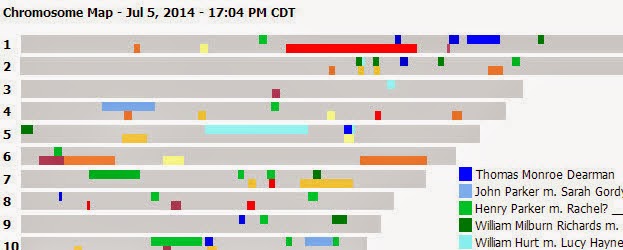
Debbie Parker Wayne, Partial Display of Mapped Chromosome Segments, 5 July 2014, created with Chromosome Mapping Tool by Kitty Cooper (http://kittymunson.com/dna/ChromosomeMapper.php : accessed 5 July 2014).

Is it worthwhile to take a DNA test for genealogy?
Yes, unequivocally for most of us.

For yourself, how much you will learn depends on how much effort you are willing to put in to learning how to use DNA evidence. For more information see Debbie Parker Wayne, "Disappointed in DNA test results?," Deb's Delvings Blog, posted 16 September 2013 (http://debsdelvings.blogspot.com/2013/09/disappointed-in-dna-test-results.html : accessed 3 January 2015). There are hundreds of blogs posts out there from dozens of genetic genealogists on how to use DNA test results.

For others, your DNA and family tree may provide the match needed to break down a long standing brick wall. Or for someone who has no knowledge of her biological parents to connect to family.

For the future, one of the best reasons to take a DNA test is to "bank" your DNA or the DNA of elderly relatives for future testing. As much as we know today about DNA, more will be known in the future. Our grandkids and great-grandkids may learn more from our DNA than we will be able to learn.

Today, Family Tree DNA advertises DNA samples will be stored to allow for testing in the future. Other companies may store leftover biological material, but they do not allow additional tests to be ordered at this time. No company can guarantee there will be enough stored material or viable DNA material for a particular test. But if the material is not stored and made available then there is NO chance of testing once a relative is deceased.

Is one company more economical than the others?
See Judy G. Russell, "2014: Most bang for DNA bucks," The Legal Genealogist blog, posted 6 April 2014 (http://www.legalgenealogist.com/blog/2014/04/06/2014-most-bang-for-dna-bucks/ : accessed 3 January 2015).

What will I learn?
A DNA test will provide several types of information: a list of other people in the database of the testing company who have DNA that matches yours and values for the DNA markers tested. Depending on the type of DNA test the markers and values will vary. For some test types, the companies provide an ethnicity prediction based on comparison to the population database used by the testing company.

Notice use of the phrase "the testing company" above. This means you may get different lists of people with matching DNA at each company because different people tested at each company and different ethnicity predictions because each company uses a different population database. This is why testing at all three companies is recommended. More on test types, databases, and ethnicity predictions below.

What kinds of tests are offered for genetic genealogy?
Y-DNA tests have been offered for about fifteen years now. Only men have Y-DNA; Y-DNA is passed from father to son. You can only learn about the direct patrilineal line of the man tested, and Y-DNA can be traced back many generations.

Mitochondrial DNA (mtDNA) tests have also been offered for about fifteen years now. Both men and women have mtDNA; mtDNA is passed from mother to all children; only daughters pass mtDNA to the next generation. You can only learn about the direct matrilineal line of the person tested, and mtDNA can be traced back many generations.

Autosomal DNA (atDNA) tests have been widely available for over five years now. Both men and women have atDNA; atDNA is passed from both parents, they inherited it from both of their parents, and so on. You can learn about every line on the pedigree chart of the person tested, but atDNA can only be traced back easily and reliably a limited number of generations. As you go back more generations it generally gets more difficult to use atDNA for genealogical evidence.

What can you learn from a Y-DNA test?
See Debbie Parker Wayne, "Using Y-DNA for Genealogy," National Genealogical Society, NGS Magazine 40 (January-March 2014): 20-24; PDF online (http://debbiewayne.com/pubs/pub_NGSMag_201311_Y-DNA_ALL.pdf : accessed 3 January 2015).

What can you learn from an mtDNA test?
See Debbie Parker Wayne, "Using mitochondrial DNA for Genealogy," National Genealogical Society, NGS Magazine 39 (October-December 2013): 26-30; PDF online (http://debbiewayne.com/pubs/pub_NGSMag_201308_mtDNA_ALL.pdf : accessed 3 January 2015).

What can you learn from an atDNA test?
See Debbie Parker Wayne, "Using autosomal DNA for Genealogy," National Genealogical Society, NGS Magazine 40 (April-June 2014), 50-54; PDF online (http://debbiewayne.com/pubs/pub_NGSMag_201402_atDNA_ALL.pdf : accessed 3 January 2015)
and
Debbie Parker Wayne, "Using X-DNA for Genealogy," National Genealogical Society, NGS Magazine 40 (July-September 2014): 57-61; PDF online (http://debbiewayne.com/pubs/pub_NGSMag_201405_X-DNA_ALL.pdf : accessed 3 January 2015).

Which company should I test with ... if I am interested in testing myself and I have no specific goal in mind? I just think DNA testing is cool and I want to do it.
Take an autosomal DNA test with all three of the "big" genetic genealogy testing companies. If you also want to contribute to anthropological discoveries for the human race test at National Geographic Genographic Project.

This can be accomplished by ordering individual tests from each company or by testing separately at 23andMe and AncestryDNA then transferring results from AncestryDNA to Family Tree DNA. Family Tree DNA does the lab work for National Geographic so results from the Genographic Project can be transferred to the Family Tree DNA database then additional tests can be ordered using the same DNA sample provided for National Geographic.

The only test offered by three of the companies is primarily an autosomal test so you don't have to know a specific name for the test. Family Tree DNA offers other tests so you must order a "Family Finder" test to get the autosomal DNA test there.

Does my ethnicity affect which company I should test with?
It depends.

Some factors to consider include (statements based on my personal experience and statements made by other genetic genealogists that I trust, your experience may vary):
  • African American ancestry: 23andMe actively recruited African and African American testers so have a significant number of testers in their database. AncestryDNA, by providing access to many family trees and documents, can make it easier to see patterns that can link slaveholders and ancestors who were held in slavery. Family Tree DNA uses a higher threshold that seems to result in fewer DNA matches for many African American researchers.
  • American Colonial ancestry: AncestryDNA's database includes more testers with deep colonial American ancestry, but all of the testing companies cover many in this category.
  • Ashkenazi Jewish ancestry, and others where small populations intermarried: These intermarriages result in a lot of small shared DNA segments that confuse the algorithms into predicting a closer relationship between two testers. Family Tree DNA has a lot of expertise in this area for those with Ashkenazi Jewish ancestry. AncestryDNA modified their match algorithm recently and may get better in this area. 23andMe limits the number of matches seen by a tester so some relatives may not be seen in the DNA match list.
  • Native American: Where Native American ancestry is suspected on the direct patrilineal line a Y-DNA test gives conclusive results. Where Native American ancestry is suspected on the direct matrilineal line an mtDNA test gives conclusive results. Where Native American ancestry is suspected on other lines, an autosomal DNA may or may not provide evidence.

    If the Native American ancestor is within five or so generations of a tester, it is likely to be detected. If it is more generations to the Native American ancestor, or random recombination of DNA resulted in the tester not having a detectable amount of DNA from that particular ancestor, Native American ancestry may not be detected even though it exists in the lineage. Testing other cousins in this line may result in detectable amounts of Native American DNA.

    23andMe uses an algorithm that seems to detect small amounts of Native American DNA not reported by the other companies
  • Old World lineage (not North or South American): Today, 23andMe and Family Tree DNA have more testers in their databases from outside of the Americas. AncestryDNA is about to offer testing outside of the USA so their database of testers from other locales may grow soon.

Will I learn about health related issues from a genetic genealogy test?
If you are interested in learning health related information, testing at 23andMe or AncestryDNA will provide more medically-significant markers. The data from the testing company can be analyzed by Promethease or other third-party tools. At some point in the future, 23andMe may again provide links to the medically significant information without the need for a third-party tool.

Which testing company is easiest? I don't have time to learn how to analyze DNA.
Testing at AncestryDNA may be the easiest for those who are not willing to invest time in learning how to use DNA results effectively for genealogical research. A public tree on Ancestry helps to get the most from a DNA test taken at Ancestry.

AncestryDNA does not provide the detailed segment data needed to make use of the most popular DNA analysis tools. Those who have tested at AncestryDNA and want to do detailed analysis must upload the raw DNA data to a third-party website (such as GEDmatch) or use third-party utilities (of which there are many). Comparisons can only be done with others who have also uploaded to the same site.

You can learn SO MUCH MORE from your DNA tests if you are willing to invest some time in learning how DNA answers genealogical questions. The image above labeled "Partial Display of Mapped Chromosome Segments" shows how some are mapping particular segments of chromosomes to specific ancestors using detailed DNA analysis and tools written by genetic genealogists with programming skills.


geralt, stress___burnout-231452_1280.jpg, "Burnout Man Psychology Rays Stress Hand Face Old," PixBay (http://pixabay.com/en/burnout-man-psychology-rays-stress-231452/ : accessed 16 July 2014), Public Domain CC0 license.

How do I learn to make effective and detailed use of DNA to answer genealogical questions?
  1. Learn about genetic genealogy and analysis techniques. Places for more information include:
  2. Practice the techniques on your own family data.

Choosing a testing company when you can't afford to test at all three may be affected by the following considerations.

Is support via telephone an important consideration?
Both Family Tree DNA and AncestryDNA provide telephone support, but the knowledge level of the customer service representatives covers a wide spectrum. In my experience and anecdotally, Family Tree DNA excels in both telephone and e-mail support to customers, quickly getting more knowledgeable persons involved if the first rep contacted cannot answer a question.

23andMe offers support online and not via telephone. Their customer support representatives have a reputation for providing knowledgeable and useful answers.

Are you testing an elderly relative who has trouble producing saliva?
Family Tree DNA uses a cheek swab to obtain a DNA sample (the tester rubs the swab on the inside of the cheek, cheek cells collect on the cotton swab). This is easier for many elderly people. As a special request option, 23andMe offers a test kit that requires less saliva than the standard test.

The ways we use DNA and the tools we use will continue to advance and change over the coming years. We will all need to continue our education as those advances come.

** Disclaimer: I coordinate the "Practical Genetic Genealogy" courses offered at GRIP and the "Getting Started with Genetic Genealogy" course offered in 2015 at SLIG. Back in 2010 I started planning topics I thought should be offered in a week-long institute for genetic genealogists. I then searched for the best people to help teach the course and found CeCe Moore and Blaine Bettinger. We had similar ideas about what was needed to bring the genealogy and genetic genealogy communities together. CeCe and Blaine helped refine the session topics based on their experiences. In July 2014 our plans came to fruition with the first "Practical Genetic Genealogy" course offered at GRIP. More and more institutes and conferences are offering more advanced genetic genealogy education.


To cite this blog post:
Debbie Parker Wayne, "Which DNA test should I take?," Deb's Delvings Blog, posted 3 January 2015 (http://debsdelvings.blogspot.com/ : accessed [date]).

© 2015, Debbie Parker Wayne, CG, CGL, All Rights Reserved

04 December 2014

Prep for Genetic Genealogy Training at Institutes

More and more educational opportunities are becoming available for genetic genealogists. Week long courses offered at several institutes are available. How do you decide which course is best for you? How do you prepare to get the most from an institute course?

Blaine Bettinger, CeCe Moore, and I worked together to put together the first week-long course in the U.S. "Practical Genetic Genealogy" was offered at the Genealogical Research Institute of Pittsburgh (GRIP) in July 2014. As best we can determine, it was the first in the world. This course, the DNA Day offered at SoCal Jamboree in 2013, the Institute for Genetic Genealogy (I4GG)'s International Genetic Genealogy Conference in August 2014, and many more genetic genealogy events have generated a lot of interest in educational opportunities.


Upcoming beginner and intermediate genetic genealogist institute courses include

All of these courses cover Y-DNA, mtDNA, X-DNA, and atDNA topics. The depth of the material covered, the examples used, and the ancillary topics vary between the courses.

The SLIG course is aimed at those who are new to genetic genealogy or someone who knows a little and wants to learn more. The focus is on using genetic genealogy for personal family history research. The SLIG course is good for someone with no or only a basic understanding of genetic genealogy.

The GRIP course can also be attended by novice genetic genealogists, but some more advanced topics are covered. Topics primarily of interest to project administrators and professional genealogists working with clients are included. The GRIP course could be attended by someone with only a little understanding of genetic genealogy, but there will be some advanced topics that you may not comprehend.

Learning genetic genealogy is like any other subject. You cannot go from no knowledge to subject matter expert in one week. Expertise is developed by experience over time. Each time a topic is studied some new information will be grasped. You become a better cook over time; with experience you understand techniques you could not handle as a novice. To become a better genetic genealogist requires learning the basics, putting it in to practice, then learning more advanced techniques that were not clear before you had the experience as a foundation. This cycle will continue as new DNA discoveries, tests, tools, and techniques are happening almost every day.

For either the SLIG or GRIP course, any student who is willing to spend some time studying before the institute will get more from the course. The course will provide foundational knowledge. Those who already have some foundational knowledge to build on will learn even more.

To prepare to learn as much as possible at an institute genetic genealogy course you should read and study at least two of the following books.
  1. Bettinger, Blaine, PhD (Biochemistry), JD and Matt Dexter. I Have the Results of My Genetic Genealogy Test, Now What? (self-published, 2008); v2.1 version with atDNA added is available from http://www.familytreedna.com/pdf-docs/Interpreting-Genetic-Genealogy-Results_web_optimized.pdf.
  2. Hill, Richard. Finding Family: My Search for Roots and the Secrets in My DNA. n.p.: self-published, 2012.
  3. Kennett, Debbie. DNA and Social Networking: A Guide to Genealogy in the Twenty-first Century. Gloucestershire, UK: The History Press, 2011.
  4. Smolenyak, Megan Smolenyak and Ann Turner. Trace Your Roots with DNA. Emmaus, Penn., Rodale Press, 2004. Primarily covers Y-DNA and mtDNA and discoveries since 2004 are not included.
  5. Wheaton, Kelly. Beginner’s Guide to Genetic Genealogy. https://sites.google.com/site/wheatonsurname/beginners-guide-to-genetic-genealogy/.
More information can be found in the following book, but it jumps into some advanced definitions that may scare away a novice:
  • Aulicino, Emily D. Genetic Genealogy: The Basics and Beyond. Bloomington, Ind.: AuthorHouse, 2013.

The following are a small number of the blogs available. These will also provide basic information, but may not be as complete as in the books and will not be organized as a book is.

Keep up with announcements of any future offerings through the institutes, blogs, mail lists, forums, and Facebook posts by genetic genealogists.


To cite this blog post:
Debbie Parker Wayne, "Prep for Genetic Genealogy Training at Institutes," Deb's Delvings Blog, posted 4 December 2014 (http://debsdelvings.blogspot.com/ : accessed [date]).

© 2014, Debbie Parker Wayne, CG, CGL, All Rights Reserved

29 June 2014

Openings in Practical Genetic Genealogy at GRIP 2014

I just heard we had some cancellations so we have a couple of open seats in the Practical Genetic Genealogy course at the Genealogical Research Institute of Pittsburgh (GRIP). The course runs from July 20-25, 2014, in Pittsburgh at LaRoche College. This is the first week-long genetic genealogy course to be offered in the U.S. The course is a mixture of classroom presentations and hands-on exercises. The best way to learn how to use DNA for genealogy is to do it!

A registration waitlist link is at http://www.gripitt.org/?page_id=73 or just e-mail info@GRIPitt.org with a subject like "WAITLIST Practical Genetic Genealogy."

The course description is at http://www.gripitt.org/?page_id=1147. The GRIP website also has travel information and everything you need to know about the institute and the facilities.

A few people told me they wanted to get in, but were too late. Now is your chance. I wish I had e-mail addresses to contact those people directly, but most I met at conferences or society meetings and have no contact information. If you know someone who might be interested please pass this on.

The course will be taught by Blaine Bettinger, CeCe Moore, and me. We have divided up the topics so we each teach the sessions we have the most expertise and interest in. We are looking forward to seeing everyone there and know it will be a great group to be part of.

© 2014, Debbie Parker Wayne, CG, CGL, All Rights Reserved

09 February 2014

Registration Feb. 12th for Practical Genetic Genealogy at GRIP

Ten or so years ago I wished for an in-depth training class on using DNA for genealogy.

Genetic genealogists were mostly self-taught. Around that time Family Tree DNA started offering a two-day conference for project administrators. I wasn’t an admin at that time so I couldn’t attend. Megan Smolenyak and Ann Turner published their book on using DNA to Trace Your Roots.1 Colleen Fitzpatrick had a DNA section in Forensic Genealogy.2 Ann Turner had started the genealogy-dna mail list on RootsWeb.3 Other educational opportunities were mostly non-existent other than one-hour introductory presentations at conferences and seminars. You can’t do in-depth in one hour when you have to start with the basics.

Five or so years ago a group of professional and aspiring professional genealogists discussed whether or not there was enough a genealogist needs to learn about DNA to fill a week-long institute course. My response was a resounding YES even as I got some very skeptical looks from others. I had already started a list of things I thought should be included. And this was before I knew much about autosomal DNA.

I refined my list of potential topics. I sat in on sessions looking for good speakers who were knowledgeable about the topic. In my opinion, a good genetic genealogy speaker doesn’t just teach the scientific facts. The good genetic genealogy speaker, when speaking to a newbie or general audience, has to be able to choose the part of the science a genealogist must understand and eliminate the part only the scientist or DNA nerd needs. The good genetic genealogy speaker has to be able to relate the required scientific knowledge to what a genealogist already knows about research. The good genetic genealogy speaker has experience using the latest DNA analysis techniques and can demonstrate those techniques so any motivated genealogist can learn them. The good genetic genealogy speaker keeps up with the latest developments in the community.


In 2012 I met and became friends with a group I felt I would enjoy working with and who I knew would present a course I would want to attend myself. In 2013 our course proposal was accepted.

This year all of that planning becomes a reality as CeCe Moore, Blaine Bettinger, and I offer the first week-long genetic genealogy course at a genealogy institute in the U.S. – Practical Genetic Genealogy.


Registration starts February 12th at the Genealogical Research Institute of Pittsburgh (GRIP) for the Practical Genetic Genealogycourse offered on July 20-25, 2014.

The course outline is available at http://www.gripitt.org/?page_id=1147.

The course is expected to fill up quickly if everyone who has told us they want to attend really tries to register. Tips for Quickly Getting Through Registration is available at http://www.gripitt.org/?p=1296

I am looking forward to this so much as I hope we can help others learn what I wish someone had been around to teach me ten years ago.


1. Megan Smolenyak Smolenyak and Ann Turner, Trace Your Roots with DNA (Emmaus, Penn., Rodale Press, 2004).
2. Colleen Fitzpatrick, Forensic Genealogy (Fountain Valley, Cal., Rice Book Press, 2005).
3. Ann Turner, founder, Genealogy-DNA List on RootsWeb ( http://lists.rootsweb.com/index/other/DNA/GENEALOGY-DNA.html).


To cite this blog post:
Debbie Parker Wayne, "Registration Feb. 12th for Practical Genetic Genealogy at GRIP," Deb's Delvings Blog, posted 9 February 2014 (http://debsdelvings.blogspot.com/ : accessed [date]).

© 2014, Debbie Parker Wayne, CG, CGL, All Rights Reserved