23 February 2015

Genetic Genealogy at GRIP 2015

The availability of genetic genealogy education this past year or two has soared. In addition to many regular conference sessions and one-day pre-conference offerings focused on genetic genealogy, last year saw the first week-long courses in genetic genealogy offered at the Genealogical Research Institute of Pittsburgh (GRIP). We filled two sessions. Then in January at Salt Lake Institute of Genealogy (SLIG) we filled a getting started course and an advanced course.

Registration for GRIP 2015 has started. This year GRIP is offering courses on two dates, (1) June 28 to July 3, 2015, and (2) July 19 to July 24, 2015. We still have openings for "Practical Genetic Genealogy" in both sessions.

Sessions offered starting June 28th include:
  • Writing Your Immigrant Families’ Stories: From Research to Publishing with John P. Colletta, PhD and Michael Hait, CG
  • Determining Kinship Reliably with the Genealogical Proof Standard with Thomas W. Jones, PhD, CG, CGL
  • Research in New York State: Resources and Strategies with Karen Mauer Jones, CG, FGBS (formerly Green)
  • Problem Solving with Church Records with Rev. Dr. David McDonald, CG
  • Advanced Research Tools: Land Records with Richard G. Sayre, CG, CGL and Pamela Boyer Sayre, CG, CGL
  • Practical Genetic Genealogy with Debbie Parker Wayne, CG, CGL, CeCe Moore and Blaine Bettinger, PhD, JD

Sessions offered starting July 19th include:
  • Intermediate Genealogy: Tools for Digging Deeper with Paula Stuart-Warren, CG, FMGS, FUGA
  • Advanced Research Methods with Thomas W. Jones, PhD, CG, CGL
  • Refresh, Rebuild and Recharge Your Genealogy Career with D. Joshua Taylor, MA, MLS
  • Pennsylvania: Research in the Keystone State with Sharon Cook MacInnes, PhD and Michael D. Lacopo, DVM
  • Law School for Genealogists with Judy G. Russell, JD, CG, CGL and Richard G. “Rick” Sayre, CG, CGL
  • Practical Genetic Genealogy with Debbie Parker Wayne, CG, CGL, Patti Hobbs, CG, and Blaine Bettinger, PhD, JD

The 2015 "Practical Genetic Genealogy" course has been modified based on our experience and on suggestions from 2014 attendees. The GRIP course still goes more in-depth than the getting started course did at SLIG. Several topics have been compressed or removed, without removing any critical content. This makes time for two new sessions illustrating genealogical problem solving using genetic genealogy tools such as GenomeMate, Genetic Genealogy Kit (GGK), utilities on DNAgedcom or GEDmatch, or other useful tools.


CeCe Moore, Blaine Bettinger, and I will speak again at GRIP. We are also adding a new speaker.


Patti Hobbs will be joining us this year at GRIP in July. She has been focused on completing her portfolio for the Board for Certification of Genealogists. I was able to convince her to attend the 2014 "Practical Genetic Genealogy" course with the idea she would help teach once she completed her portfolio. It was not a surprise to anyone who knows her when we saw the announcement that Patricia Lee Hobbs was now a board-certified genealogist. Her knowledge of biology helps her understand more than many of us about how DNA can be used in genealogy, her teaching and speaking skills help her explain complex concepts in an easy to understand way, her credentials demonstrate she knows traditional research. Patti will be a great addition as we focus on correlating genetics and documentary evidence to solve genealogical problems.

CeCe Moore is well-known as the genetic genealogy consultant for Finding Your Roots with Henry Louis Gates, Jr. and Genealogy Roadshow, both on PBS. She has worked many high-profile cases that used DNA to trace family history, seen on television on 20/20, CBS This Morning, and The Doctors. She also works extensively with individuals of unknown parentage to help them learn about their genealogy through DNA, often reuniting them with biological family members. CeCe uses case studies from her work to illustrate how autosomal DNA can help solve genealogical problems.

Blaine Bettinger, PhD (Biochemistry), JD, is also well-known in the genetic genealogy community. Blaine is an intellectual property attorney and blogs as The Genetic Genealogist. He chaired a committee that formed Genetic Genealogy Standards to help us all as we navigate this exciting field of research. Blaine's experience as a project administrator and in using genetic genealogy for his own research provide useful examples for students.

I am a full-time, professional genealogist experienced using DNA analysis, as well as more traditional techniques, for genealogical research. My client projects include both documentary research and DNA analysis. My family research incorporates both. I performed research for television shows such as the Canadian series Ancestors in the Attic, the PBS series Finding Your Roots with Henry Louis Gates Jr., and The Learning Channel’s Who Do You Think You Are?.

Between the four of us, we have wide-ranging experience in documentary research and genetic genealogy. We all enjoy showing others how exciting it can be to solve genealogical problems with DNA test results. We want all of our students to leave with knowledge they can immediately put to use, gained from hands-on experience using DNA evidence from real family history stories.

Because genetic genealogy is a complex topic some concepts are best retained when heard more than once. Our reading list includes some books that will give you a head start. My online bibliography also has links to some articles freely available online and to some videos.

We'd love to have you join us. The GRIP registration page is here.


To cite this blog post:
Debbie Parker Wayne, "Genetic Genealogy at GRIP 2015," Deb's Delvings Blog, posted 23 February 2015 (http://debsdelvings.blogspot.com/ : accessed [date]).

© 2015, Debbie Parker Wayne, CG, CGL, All Rights Reserved

13 February 2015

DNA Quick Reference Notes


This post has been superceded by the updated documents and additional information in the Publications area of my website.


I've been promising students in the genetic genealogy sessions at the
Genealogical Research Institute of Pittsburgh (GRIP), the
Forensic Genealogy Institute, the Institute for Genetic Genealogy (I4GG), the Salt Lake Institute of Genealogy (SLIG), and many of my other presentations that I would put copies of my Quick Reference DNA documents on this blog where they could get copies. I'm finally fulfilling that promise so everyone can print color copies of the complete document even if only portions or non-color copies were provided in syllabus material.

Many of these have a Creative Commons license so others can improve them as long as copies are freely provided to others under the same licensing scheme.

Documents I keep close when doing genetic genealogy include:

QuickRef___DNA_mt_.pdf - mtDNA QuickRef with my mtDNA molecule diagram, mtDNA Regions and Common Ancestor Matches chart, Family Tree DNA Match List Threshold chart, Native American mtDNA Haplogroups table, and Heteroplasmy notes.

QuickRef___DNA_Y.pdf - Y-DNA STR Marker chart noting fast-mutating markers, conversion between AncestryDNA and Family Tree DNA marker values, and noting which Family Tree DNA markers were tested by AncestryDNA.

QuickRef_DNA_inherited_atDNA.pdf - table with Percentage of Shared Autosomal DNA averages by relationship, some shared percentage ranges and some cM values also included.

Xinherit_chart_femalecolored.pdf - X-DNA Inheritance Chart for Female Focus Person.

Xinherit_chart_malecolored.pdf - X-DNA Inheritance Chart for Male Focus Person.


To cite this blog post:
Debbie Parker Wayne, "DNA QuickRef Notes," Deb's Delvings Blog, posted 13 February 2015 (http://debsdelvings.blogspot.com/ : accessed [date]).

© 2015, Debbie Parker Wayne, CG, CGL, All Rights Reserved

Hands-On Workshops for All Serious Genealogists


I can't count the number of times I have attended a lecture, thought I perfectly understood what the speaker was saying, then could not figure out how to put what I had learned into practice after I got home. Most of us learn more by doing than by listening. For more advanced concepts this "doing" can be even more important than it is in a basics class.

The BCG Education Fund Putting Skills to Work workshops give us two different half-day workshops in one day. Both workshops are at an intermediate to advanced level. Both provide hands-on exercises designed to complement the lecture material so we go home with practical skills we can immediately make use of. We leave knowing how to put what we learned into practice because we've already done so.


At the NGS conference this year in St. Charles, Missouri, the BCG Education Fund, an independent charitable trust, sponsors the Putting Skills to Work workshops, on Tuesday, 12 May 2015, 8:30 am–4:30 pm.

This intensive day of learning, limited to sixty students, focuses on skills needed by any genealogist and advocates established standards of the genealogical field. Topics are geared to intermediate and advanced practitioners. The registration fee of $110 includes lunch, hands-on exercises, and syllabus. NGS Conference registration is not required.

These workshops are unique offerings even when the title is similar to sessions taught by these speakers in the past. Workshop attendees will participate in one workshop in the morning and the second workshop in the afternoon, getting both of these useful topics in one day.

Barbara J. Mathews, CG, will lead the session "Evidence Analysis, Correlation, and Resolution: The Heart of the Genealogical Proof Standard." Focusing on only direct evidence creates unnecessary research dead ends. This session addresses weighing and correlating sources, evidence, and information in its diverse forms for successful resolution of thorny problems. There will be hands-on exercises and active class participation.


Elissa Scalise Powell, CG, CGL, will lead the session "Baker's Dozen Steps to Writing Research Reports." Many researchers think that committing their research to paper is a separate process from performing the research. Use these thirteen steps to "write as you go" to use time more efficiently, drive the research process, and produce a sharable work product.


Every genealogist needs to understand how to analyze and correlate evidence to ensure we place our ancestors in the correct families. We all should be writing reports, even if those reports are only to ourselves, so that we don't waste time trying to remember what we did when we last worked on a particular line.

Come join these two experts and learn ways to efficiently and accurately perform research and record it.

Registration is through the NGS Conference registration site at http://conference.ngsgenealogy.org/. If you've already registered for the conference, just login and add the Putting Skills to Work workshop. If you haven't registered yet, now is the time to do it!

For more information see BCG Education Fund

and

http://bcgcertification.org/blog/2014/12/bcg-education-fund-workshop-at-ngs-st-charles-12-may-2015/.


To cite this blog post:
Debbie Parker Wayne, "Hands-On Workshops for All Serious Genealogists," Deb's Delvings Blog, posted 13 February 2015 (http://debsdelvings.blogspot.com/ : accessed [date]).

© 2015, Debbie Parker Wayne, CG, CGL, All Rights Reserved

03 January 2015

Which DNA test should I take?

Which DNA test should I take? Is it worthwhile? What will I learn?

I see these and similar questions asked dozens of times a day on mail lists, forums, and social media sites. Some people recommend what worked for them, but what was "best" for us may not be best for the person asking today.


Chart of one person's number of Family Finder matches at Family Tree DNA over several years.

A DNA test is the genealogical resource that keeps on giving: as more people test you will get more matches. After taking a DNA test you need to periodically look at data for your new matches. You never know when the person whose DNA can solve your hardest genealogical problem will take a DNA test.

Knowing how DNA test results could contribute evidence to answer your genealogical question is critical to knowing which test to take and where. So here are some specific questions with the answer I would give today. As companies change their lab procedures, sequencing techniques, databases, tool offerings, customer service, and we learn more about DNA, these answers might change. As new companies are formed, these answers might change.

The three biggest genetic genealogy testing companies include Family Tree DNA, 23andMe, and AncestryDNA. For anthropological testing that may also be applied to genealogical research there is the National Geographic Genographic Project.

Many other companies also offer specialty testing and analysis services for those unable to do the analysis themselves. The "big three" will be the primary focus of this article. For the tests that are offered by all three companies, the base price of the tests is the same, although sale prices can provide significant savings. To find out about sales read the posts of genetic genealogists on blogs, Facebook, mail lists, and forums.


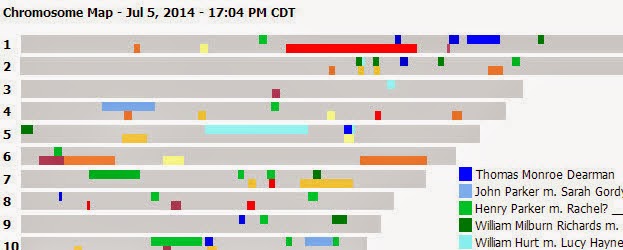
Debbie Parker Wayne, Partial Display of Mapped Chromosome Segments, 5 July 2014, created with Chromosome Mapping Tool by Kitty Cooper (http://kittymunson.com/dna/ChromosomeMapper.php : accessed 5 July 2014).

Is it worthwhile to take a DNA test for genealogy?
Yes, unequivocally for most of us.

For yourself, how much you will learn depends on how much effort you are willing to put in to learning how to use DNA evidence. For more information see Debbie Parker Wayne, "Disappointed in DNA test results?," Deb's Delvings Blog, posted 16 September 2013 (http://debsdelvings.blogspot.com/2013/09/disappointed-in-dna-test-results.html : accessed 3 January 2015). There are hundreds of blogs posts out there from dozens of genetic genealogists on how to use DNA test results.

For others, your DNA and family tree may provide the match needed to break down a long standing brick wall. Or for someone who has no knowledge of her biological parents to connect to family.

For the future, one of the best reasons to take a DNA test is to "bank" your DNA or the DNA of elderly relatives for future testing. As much as we know today about DNA, more will be known in the future. Our grandkids and great-grandkids may learn more from our DNA than we will be able to learn.

Today, Family Tree DNA advertises DNA samples will be stored to allow for testing in the future. Other companies may store leftover biological material, but they do not allow additional tests to be ordered at this time. No company can guarantee there will be enough stored material or viable DNA material for a particular test. But if the material is not stored and made available then there is NO chance of testing once a relative is deceased.

Is one company more economical than the others?
See Judy G. Russell, "2014: Most bang for DNA bucks," The Legal Genealogist blog, posted 6 April 2014 (http://www.legalgenealogist.com/blog/2014/04/06/2014-most-bang-for-dna-bucks/ : accessed 3 January 2015).

What will I learn?
A DNA test will provide several types of information: a list of other people in the database of the testing company who have DNA that matches yours and values for the DNA markers tested. Depending on the type of DNA test the markers and values will vary. For some test types, the companies provide an ethnicity prediction based on comparison to the population database used by the testing company.

Notice use of the phrase "the testing company" above. This means you may get different lists of people with matching DNA at each company because different people tested at each company and different ethnicity predictions because each company uses a different population database. This is why testing at all three companies is recommended. More on test types, databases, and ethnicity predictions below.

What kinds of tests are offered for genetic genealogy?
Y-DNA tests have been offered for about fifteen years now. Only men have Y-DNA; Y-DNA is passed from father to son. You can only learn about the direct patrilineal line of the man tested, and Y-DNA can be traced back many generations.

Mitochondrial DNA (mtDNA) tests have also been offered for about fifteen years now. Both men and women have mtDNA; mtDNA is passed from mother to all children; only daughters pass mtDNA to the next generation. You can only learn about the direct matrilineal line of the person tested, and mtDNA can be traced back many generations.

Autosomal DNA (atDNA) tests have been widely available for over five years now. Both men and women have atDNA; atDNA is passed from both parents, they inherited it from both of their parents, and so on. You can learn about every line on the pedigree chart of the person tested, but atDNA can only be traced back easily and reliably a limited number of generations. As you go back more generations it generally gets more difficult to use atDNA for genealogical evidence.

What can you learn from a Y-DNA test?
See Debbie Parker Wayne, "Using Y-DNA for Genealogy," National Genealogical Society, NGS Magazine 40 (January-March 2014): 20-24; PDF online (http://debbiewayne.com/pubs/pub_NGSMag_201311_Y-DNA_ALL.pdf : accessed 3 January 2015).

What can you learn from an mtDNA test?
See Debbie Parker Wayne, "Using mitochondrial DNA for Genealogy," National Genealogical Society, NGS Magazine 39 (October-December 2013): 26-30; PDF online (http://debbiewayne.com/pubs/pub_NGSMag_201308_mtDNA_ALL.pdf : accessed 3 January 2015).

What can you learn from an atDNA test?
See Debbie Parker Wayne, "Using autosomal DNA for Genealogy," National Genealogical Society, NGS Magazine 40 (April-June 2014), 50-54; PDF online (http://debbiewayne.com/pubs/pub_NGSMag_201402_atDNA_ALL.pdf : accessed 3 January 2015)
and
Debbie Parker Wayne, "Using X-DNA for Genealogy," National Genealogical Society, NGS Magazine 40 (July-September 2014): 57-61; PDF online (http://debbiewayne.com/pubs/pub_NGSMag_201405_X-DNA_ALL.pdf : accessed 3 January 2015).

Which company should I test with ... if I am interested in testing myself and I have no specific goal in mind? I just think DNA testing is cool and I want to do it.
Take an autosomal DNA test with all three of the "big" genetic genealogy testing companies. If you also want to contribute to anthropological discoveries for the human race test at National Geographic Genographic Project.

This can be accomplished by ordering individual tests from each company or by testing separately at 23andMe and AncestryDNA then transferring results from AncestryDNA to Family Tree DNA. Family Tree DNA does the lab work for National Geographic so results from the Genographic Project can be transferred to the Family Tree DNA database then additional tests can be ordered using the same DNA sample provided for National Geographic.

The only test offered by three of the companies is primarily an autosomal test so you don't have to know a specific name for the test. Family Tree DNA offers other tests so you must order a "Family Finder" test to get the autosomal DNA test there.

Does my ethnicity affect which company I should test with?
It depends.

Some factors to consider include (statements based on my personal experience and statements made by other genetic genealogists that I trust, your experience may vary):
  • African American ancestry: 23andMe actively recruited African and African American testers so have a significant number of testers in their database. AncestryDNA, by providing access to many family trees and documents, can make it easier to see patterns that can link slaveholders and ancestors who were held in slavery. Family Tree DNA uses a higher threshold that seems to result in fewer DNA matches for many African American researchers.
  • American Colonial ancestry: AncestryDNA's database includes more testers with deep colonial American ancestry, but all of the testing companies cover many in this category.
  • Ashkenazi Jewish ancestry, and others where small populations intermarried: These intermarriages result in a lot of small shared DNA segments that confuse the algorithms into predicting a closer relationship between two testers. Family Tree DNA has a lot of expertise in this area for those with Ashkenazi Jewish ancestry. AncestryDNA modified their match algorithm recently and may get better in this area. 23andMe limits the number of matches seen by a tester so some relatives may not be seen in the DNA match list.
  • Native American: Where Native American ancestry is suspected on the direct patrilineal line a Y-DNA test gives conclusive results. Where Native American ancestry is suspected on the direct matrilineal line an mtDNA test gives conclusive results. Where Native American ancestry is suspected on other lines, an autosomal DNA may or may not provide evidence.

    If the Native American ancestor is within five or so generations of a tester, it is likely to be detected. If it is more generations to the Native American ancestor, or random recombination of DNA resulted in the tester not having a detectable amount of DNA from that particular ancestor, Native American ancestry may not be detected even though it exists in the lineage. Testing other cousins in this line may result in detectable amounts of Native American DNA.

    23andMe uses an algorithm that seems to detect small amounts of Native American DNA not reported by the other companies
  • Old World lineage (not North or South American): Today, 23andMe and Family Tree DNA have more testers in their databases from outside of the Americas. AncestryDNA is about to offer testing outside of the USA so their database of testers from other locales may grow soon.

Will I learn about health related issues from a genetic genealogy test?
If you are interested in learning health related information, testing at 23andMe or AncestryDNA will provide more medically-significant markers. The data from the testing company can be analyzed by Promethease or other third-party tools. At some point in the future, 23andMe may again provide links to the medically significant information without the need for a third-party tool.

Which testing company is easiest? I don't have time to learn how to analyze DNA.
Testing at AncestryDNA may be the easiest for those who are not willing to invest time in learning how to use DNA results effectively for genealogical research. A public tree on Ancestry helps to get the most from a DNA test taken at Ancestry.

AncestryDNA does not provide the detailed segment data needed to make use of the most popular DNA analysis tools. Those who have tested at AncestryDNA and want to do detailed analysis must upload the raw DNA data to a third-party website (such as GEDmatch) or use third-party utilities (of which there are many). Comparisons can only be done with others who have also uploaded to the same site.

You can learn SO MUCH MORE from your DNA tests if you are willing to invest some time in learning how DNA answers genealogical questions. The image above labeled "Partial Display of Mapped Chromosome Segments" shows how some are mapping particular segments of chromosomes to specific ancestors using detailed DNA analysis and tools written by genetic genealogists with programming skills.


geralt, stress___burnout-231452_1280.jpg, "Burnout Man Psychology Rays Stress Hand Face Old," PixBay (http://pixabay.com/en/burnout-man-psychology-rays-stress-231452/ : accessed 16 July 2014), Public Domain CC0 license.

How do I learn to make effective and detailed use of DNA to answer genealogical questions?
  1. Learn about genetic genealogy and analysis techniques. Places for more information include:
  2. Practice the techniques on your own family data.

Choosing a testing company when you can't afford to test at all three may be affected by the following considerations.

Is support via telephone an important consideration?
Both Family Tree DNA and AncestryDNA provide telephone support, but the knowledge level of the customer service representatives covers a wide spectrum. In my experience and anecdotally, Family Tree DNA excels in both telephone and e-mail support to customers, quickly getting more knowledgeable persons involved if the first rep contacted cannot answer a question.

23andMe offers support online and not via telephone. Their customer support representatives have a reputation for providing knowledgeable and useful answers.

Are you testing an elderly relative who has trouble producing saliva?
Family Tree DNA uses a cheek swab to obtain a DNA sample (the tester rubs the swab on the inside of the cheek, cheek cells collect on the cotton swab). This is easier for many elderly people. As a special request option, 23andMe offers a test kit that requires less saliva than the standard test.

The ways we use DNA and the tools we use will continue to advance and change over the coming years. We will all need to continue our education as those advances come.

** Disclaimer: I coordinate the "Practical Genetic Genealogy" courses offered at GRIP and the "Getting Started with Genetic Genealogy" course offered in 2015 at SLIG. Back in 2010 I started planning topics I thought should be offered in a week-long institute for genetic genealogists. I then searched for the best people to help teach the course and found CeCe Moore and Blaine Bettinger. We had similar ideas about what was needed to bring the genealogy and genetic genealogy communities together. CeCe and Blaine helped refine the session topics based on their experiences. In July 2014 our plans came to fruition with the first "Practical Genetic Genealogy" course offered at GRIP. More and more institutes and conferences are offering more advanced genetic genealogy education.


To cite this blog post:
Debbie Parker Wayne, "Which DNA test should I take?," Deb's Delvings Blog, posted 3 January 2015 (http://debsdelvings.blogspot.com/ : accessed [date]).

© 2015, Debbie Parker Wayne, CG, CGL, All Rights Reserved

04 December 2014

Prep for Genetic Genealogy Training at Institutes

More and more educational opportunities are becoming available for genetic genealogists. Week long courses offered at several institutes are available. How do you decide which course is best for you? How do you prepare to get the most from an institute course?

Blaine Bettinger, CeCe Moore, and I worked together to put together the first week-long course in the U.S. "Practical Genetic Genealogy" was offered at the Genealogical Research Institute of Pittsburgh (GRIP) in July 2014. As best we can determine, it was the first in the world. This course, the DNA Day offered at SoCal Jamboree in 2013, the Institute for Genetic Genealogy (I4GG)'s International Genetic Genealogy Conference in August 2014, and many more genetic genealogy events have generated a lot of interest in educational opportunities.


Upcoming beginner and intermediate genetic genealogist institute courses include

All of these courses cover Y-DNA, mtDNA, X-DNA, and atDNA topics. The depth of the material covered, the examples used, and the ancillary topics vary between the courses.

The SLIG course is aimed at those who are new to genetic genealogy or someone who knows a little and wants to learn more. The focus is on using genetic genealogy for personal family history research. The SLIG course is good for someone with no or only a basic understanding of genetic genealogy.

The GRIP course can also be attended by novice genetic genealogists, but some more advanced topics are covered. Topics primarily of interest to project administrators and professional genealogists working with clients are included. The GRIP course could be attended by someone with only a little understanding of genetic genealogy, but there will be some advanced topics that you may not comprehend.

Learning genetic genealogy is like any other subject. You cannot go from no knowledge to subject matter expert in one week. Expertise is developed by experience over time. Each time a topic is studied some new information will be grasped. You become a better cook over time; with experience you understand techniques you could not handle as a novice. To become a better genetic genealogist requires learning the basics, putting it in to practice, then learning more advanced techniques that were not clear before you had the experience as a foundation. This cycle will continue as new DNA discoveries, tests, tools, and techniques are happening almost every day.

For either the SLIG or GRIP course, any student who is willing to spend some time studying before the institute will get more from the course. The course will provide foundational knowledge. Those who already have some foundational knowledge to build on will learn even more.

To prepare to learn as much as possible at an institute genetic genealogy course you should read and study at least two of the following books.
  1. Bettinger, Blaine, PhD (Biochemistry), JD and Matt Dexter. I Have the Results of My Genetic Genealogy Test, Now What? (self-published, 2008); v2.1 version with atDNA added is available from http://www.familytreedna.com/pdf-docs/Interpreting-Genetic-Genealogy-Results_web_optimized.pdf.
  2. Hill, Richard. Finding Family: My Search for Roots and the Secrets in My DNA. n.p.: self-published, 2012.
  3. Kennett, Debbie. DNA and Social Networking: A Guide to Genealogy in the Twenty-first Century. Gloucestershire, UK: The History Press, 2011.
  4. Smolenyak, Megan Smolenyak and Ann Turner. Trace Your Roots with DNA. Emmaus, Penn., Rodale Press, 2004. Primarily covers Y-DNA and mtDNA and discoveries since 2004 are not included.
  5. Wheaton, Kelly. Beginner’s Guide to Genetic Genealogy. https://sites.google.com/site/wheatonsurname/beginners-guide-to-genetic-genealogy/.
More information can be found in the following book, but it jumps into some advanced definitions that may scare away a novice:
  • Aulicino, Emily D. Genetic Genealogy: The Basics and Beyond. Bloomington, Ind.: AuthorHouse, 2013.

The following are a small number of the blogs available. These will also provide basic information, but may not be as complete as in the books and will not be organized as a book is.

Keep up with announcements of any future offerings through the institutes, blogs, mail lists, forums, and Facebook posts by genetic genealogists.


To cite this blog post:
Debbie Parker Wayne, "Prep for Genetic Genealogy Training at Institutes," Deb's Delvings Blog, posted 4 December 2014 (http://debsdelvings.blogspot.com/ : accessed [date]).

© 2014, Debbie Parker Wayne, CG, CGL, All Rights Reserved

25 November 2014

Holiday Sales on DNA Tests at Family Tree DNA

Family Tree DNA just announced their holiday sale starting today. In addition to great prices, there is a Mystery Reward discount, changed each week, that can be applied on top of the sale price! The Mystery Reward is tied to an account and may vary between accounts. Here is the announcement:


Dear Group Administrators,

We're excited to announce the launch of our 2014 Holiday sale! The promotion will start on November 25 (it may not be live on the site yet if you're reading this before noon Central Time) and end on December 31st @ 11:59PM Central Time.

You'll find a full list of the sale prices below. And because we're in such a festive mood, we're adding a special treat to this year's great deals - Mystery Reward discounts! The Mystery Reward will be a randomized discount (up to $100 off) that can be applied on top of the already reduced Holiday Sale prices. Best of all, you’ll get a new Mystery Reward every week. You can use the discounts or share them with friends!

The Mystery Reward icon will appear on testers’ myFTDNA dashboard each week. Each code will expire the night before the next Mystery Reward appears. We’ll also send an email notification to the kit’s primary email address when a new code is available for use or sharing.


The Mystery Rewards include both product-specific and total-purchase discounts ranging from $5 - $100 (including one for $49 off a Family Finder!) and are randomly assigned to each kit. That means not everyone gets the same reward at the same time. When you open the Mystery Reward, you’ll see a code to be used at checkout, whether it’s on your own kit or someone else’s.


In addition, all customers who have purchased the Big Y test will receive a $50 off coupon for a Big Y test, good through Dec. 31st.

Note: Only one coupon can be used per purchase.


Finally, remember that the FTDNA offices are closed the Friday after Thanksgiving. If you call and leave a message, it’s critical that you speak clearly. Please be sure to leave your contact phone number and/or email address, and the group or kit number about which you’re calling. As always, if an attempt is made during the sale period to contact us about a purchase, we will honor the sale price - and in this case, the coupon price, too.

Thank you all for your support throughout the year, and happy holidays from the team at Family Tree DNA!

Family Tree DNA
1445 North Loop West, 820, Houston, TX, 77008


To cite this blog post:
Debbie Parker Wayne, "Holiday Sales on DNA Tests at Family Tree DNA," Deb's Delvings Blog, posted 25 November 2014 (http://debsdelvings.blogspot.com/ : accessed [date]).
© 2014, Debbie Parker Wayne, CG, CGL, All Rights Reserved
12 November 2014

Openings in Getting Started with Genetic Genealogy at SLIG 2015

We've opened a few more seats in the Getting Started with Genetic Genealogy course being offered in January at the 2015 Salt Lake Institute of Genealogy (SLIG). The website is not handling these last minute openings. Contact Valerie Hansen, SLIG Registrar at sligregistrar@ugagenealogy.org if you are interested and to determine if seats are still available. SLIG announced this on their Facebook page recently so some of the seats may have been taken. Consider getting on the waiting list as there is always a possibility someone registered may have to cancel thereby opening up a seat.

The Getting Started course will help those with little or no genetic genealogy experience learn the basics. We'll also cover some intermediate level analysis techniques for genetic genealogy. Basics of Y-DNA, mitochondrial DNA, X-DNA, and autosomal DNA will be covered. Hands-on exercises illustrate how to integrate the DNA test results with your genealogical research. The focus is on using DNA for genealogy, covering only as much biology as a genealogist needs to understand. Sessions are taught by me (Debbie Parker Wayne), CeCe Moore, and Blaine Bettinger. See the SLIG website at http://www.infouga.org/cpage.php?pt=42 for more information.


To cite this blog post:
Debbie Parker Wayne, "Openings in Getting Started with Genetic Genealogy at SLIG 2015," Deb's Delvings Blog, posted 12 November 2014 (http://debsdelvings.blogspot.com/ : accessed [date]).

© 2014, Debbie Parker Wayne, CG, CGL, All Rights Reserved

28 September 2014

Free Genealogy Education from BCG, 11 October 2015, SLC

The following announcement was distributed by the Board for Certification of Genealogists® (BCG). If you will be in Salt Lake City on 11 October, be sure to take advantage of these informative lectures by some of the best speakers.
BCG OFFERS A FREE DAY OF QUALITY GENEALOGY EDUCATION OCTOBER 11

Top genealogists Elissa Scalise Powell, Judy G. Russell, Elizabeth Shown Mills, and Stefani Evans will present six lectures at the Family History Library’s Floor B2 classroom in Salt Lake City Saturday, October 11, between 9 am and 4:45 pm. The lectures are free and open to the public, sponsored by the Board for Certification of Genealogists. The board is an independent certifying body and author of the updated 2014 Genealogy Standards.

Topics and speakers:
  • 9 – “BCG Certification Seminar,” Elissa Scalise Powell, CG, CGL
  • 9:45 – “Shootout at the Rhododendron Lodge: Reconstructing Life-Changing Events,” Judy G. Russell, JD, CG, CGL
  • 11 – “From the White Lion to the Emancipation Proclamation – Slavery and the Law before the Civil War,” Judy G. Russell, JD, CG, CGL
  • 1:15 – “Using Evidence Creatively: Spotting Clues in Run-of-the-Mill Records,” Elizabeth Shown Mills, CG, CGL, FASG, FNGS, FUGA
  • 2:30 – “Oh, The Things You Can Map: Mapping Data, Memory, and Historical Context,” Stefani Evans, CG
  • 3:45 – “Trousers, Black Domestic, Tacks & Housekeeping Bills: Trivial Details Can Solve Research Problems,” Elizabeth Shown Mills, CG, CGL, FASG, FNGS, FUGA

“Whether you stop in for one lecture or all six, you will learn more about how to apply good methodology to your own family research,” said President Elissa Scalise Powell, CG, CGL. “The Board for Certification of Genealogists strives to foster public confidence in genealogy by promoting an attainable, uniform standard of competence and ethics. Educating all family historians of every level is part of this mission.”

For questions or more information contact: Nicki Birch, CG, office@BCGcertification.org.

CG, Certified Genealogist, CGL, and Certified Genealogical Lecturer are service marks of the Board for Certification of Genealogists, used under license by board certificants after periodic evaluations. The board name is a trademark registered in the US Patent and Trademark Office.


To cite this blog post:
Debbie Parker Wayne, "Free Genealogy Education from BCG, 11 October 2015, SLC," Deb's Delvings Blog, posted 28 September 2014 (http://debsdelvings.blogspot.com/ : accessed [date]).

© 2014, Debbie Parker Wayne, CG, CGL, All Rights Reserved

25 September 2014

SLIG 2015 Early Bird Deadline is October 31

The Salt Lake Institute of Genealogy (SLIG) just sent out a reminder that 31 October 2014 is the deadline to receive the Early Bird Registration discount for the January 2015 courses.
The Salt Lake Institute of Genealogy (SLIG) will be held January 12-16, 2015. All courses and events will be held at the Hilton Salt Lake City Center Hotel. Labs, if applicable, and research facilities will be available at the Family History Library.

Registration: http://www.infouga.org/aem.php?lv=r&eid=12

Early-bird registration ends on October 31, 2014. If you log in as a member first your information will be populated and you will be automatically charged the reduced rate. If you are a non-UGA member you may purchase a membership, register as a non-member, and be refunded the difference. If you have questions please call the main UGA phone number at (801) 259-4172 or email sligdirector AT ugagenealogy.org. You will be given the option to pay by credit card using PayPal (you do not have to have a PayPal account) or by sending a check.

Tuition is $375 for UGA members and $425 for non-members (a $50 savings). You MUST be logged in to the member’s area of the website prior to registering to receive the member discount. These tuition prices are applicable through October 31, 2014 when early-bird registration expires. (After October 31, 2014, tuition is $425 for UGA members and $475 for non-members). Two payment options are available: pay online with your credit card via PayPal or pay via check through the mail. Your place in the course is reserved upon checkout.

Accommodations: http://www.infouga.org/aem.php?eid=12

We recommend staying at the conference hotel, the Hilton Salt Lake City Center in order to obtain the full institute experience and have access to special events and networking with the instructors and other attendees. SLIG’s reduced rate is $129/night (reduced from $269/night). This rate is set for up to four people in a room. The rooms are spacious and a two-queen room can comfortably accommodate four people.

2015 Tracks

In 2015, SLIG is offering twelve tracks. The foremost experts in the field for each subject provide students with at least twenty hours of in-depth instruction on their topic. The format allows coordinators and instructors to build on the understanding gained from each lecture, building a foundation rather than giving scattered information. Students leave with a much deeper understanding of the topic. The following four tracks still have seats remaining:

Beyond the Library: Research in Original Source Repositories (John Colletta, Ph.D., FUGA)

This course explores repositories of original historical sources: archives, courthouses and manuscript collections. The purpose of this course is to take the mystery and trepidation out of using original source repositories.

Finding Immigrant Origins (David Ouimette, CG)

This course covers the key historical sources and research methodologies for family historians tracing immigrant origins. We explore chain migration, ethnic migration paths, surname localization, DNA evidence, cluster genealogy, and other tools to help find your immigrant’s ancestral village.

Advanced Research Tools: Post-War Military Records (Craig R. Scott, CG, FUGA)

Wars by their nature create records; however records are created in the aftermath of war also. There is the pension application file(s) or a bounty land application file(s). But there is so much more in addition to these records. There is pension law, payment ledgers, payment vouchers, public and private claims, correspondence, state claims, soldiers homes, and burial records. This course will cover these topics in-depth.

Resources and Strategies for US Research, Part I (Paula Stuart-Warren, CG, FUGA, FMGS)

This course provides in-depth study of 19th-21st century U.S. resources and methodologies for utilizing them. Analyze content, origin, location, and develop tools and strategies to interpret records.

You can also sign up for the waiting list for the other courses and you might be able to get into the course if space opens up:

The Family History Law Library (Judy G. Russell, JD, CG, CGL)

The course will cover the basic legal concepts and legal research approaches appropriate for genealogists and will require the student to employ these concepts with hands on exercises using the resources of the FHL. Topics will include courts and their records, estate laws, legislative records, pensions, and property law. Additionally, elements of both English common law and Roman law will be introduced through classes on the legal concepts found in Irish, German, and French law that relate to research in those countries and their relevance to research in the United States.

Diving Deeper into New England (D. Joshua Taylor, MA, MLS)

When encountering New England roots, many find a rich treasure of previous research, compiled materials, and records dating back to the early 1600s. Yet, within the branches of our New England roots exist assumptions, errors, missing individuals, and incomplete information. Starting with the colonial period and moving to the 1850s, “Diving Deeper into New England” will take an in-depth look at New England research, specifically focusing on little-known and underused sources.

Advanced Evidence Analysis Practicum (Angela McGhie and Kimberly Powell)

This hands-on course is an opportunity for advanced genealogists to put their research skills into practice. Participants will work on five complex genealogical research problems—a new one each day. The objective is to give each student experience in conducting research on complex problems, analyzing and correlating evidence, and reaching conclusions. The research problems will be varied, offering students the challenge of stretching their mind and skills in directions that their research may not normally take them. If you can't resist a genealogical challenge and love hands-on learning, then this is the course for you!

Getting Started with Genetic Genealogy (Debbie Parker Wayne, CG, CGL)

This course provides genealogists with the knowledge needed to correctly incorporate DNA results into their family history. Beginners will receive foundational knowledge in the basics needed to understand the application of genetics for genealogical research purposes. Those with prior knowledge of DNA will be able fill in holes in understanding and be introduced to tools and techniques with practical, hands-on exercises.

Getting More Out of Genetic Genealogy Research: Intermediate to Advanced DNA Analysis Techniques (CeCe Moore and Angie Bush, MS)

This advanced analysis coursei s intended for the genealogist who has a thorough understanding of genetic genealogy basics and has experience applying DNA testing to family history research. This is the next step in genetic genealogy education, with a focus on preparing professionals and others to work on genetic genealogy cases and strengthen the skills of those who are already doing so.

Advanced German Research (F. Warren Bittner, CG)

A comprehensive course on German research taught by one of the best researchers in this area.

From Confusion to Conclusion (Kimberly Powell and Harold Henderson, CG)

When the research is over, what next? How do genealogists transform the three-dimensional complexity of evidence into a coherent, understandable, written proof argument?

Advanced Genealogical Methods (Thomas W. Jones, Ph.D., CG, CGL)

Students in “Advanced Genealogical Methods” will learn how to use and assemble evidence to rediscover ancestral origins, identities, and relationships that have been forgotten in the passage of time. The course will address advanced use of evidence from a variety of genealogical records and research in populations for which the usual records are in short supply (including female, enslaved, and impoverished ancestors). Students also will learn how to develop written proof summaries to show their conclusions’ accuracy and create a credible record of their findings for present and future generations of family historians.


Disclosure: I will be one of the speakers at SLIG in January 2015 teaching Getting Started with Genetic Genealogy with CeCe Moore and Blaine Bettinger.


To cite this blog post:
Debbie Parker Wayne, "SLIG 2015 Early Bird Deadline is October 31," Deb's Delvings Blog, posted 25 September 2014 (http://debsdelvings.blogspot.com/ : accessed [date]).

© 2014, Debbie Parker Wayne, CG, CGL, All Rights Reserved

21 September 2014

Genetic Genealogy Education: I4GG 2014 Conference Videos

Over 400 attendees plus speakers attended the first International Conference for Genetic Genealogy in the Washington, DC, area in August 2014. The conference was organized by the Institute for Genetic Genealogy (I4GG). Most of the sessions were recorded and are now available at a great price! Over 27 hours of education for $50.00 (USD).

Tim Janzen and CeCe Moore, founders of I4GG, made this announcement today:
The videos from the 2014 International Genetic Genealogy Conference are now available for sale for those of you who were not able to attend this event. CeCe's spouse Lennart Martinsson has spent many hours editing these videos and getting them ready for you to view. Access to the videos may be purchased at http://i4gg.org/pricing. The quality of the videos that were shot in the Aiton Auditorium are generally of higher quality than the videos that were shot in the Ohio Room both from a video standpoint and an audio standpoint. We did not have permission to videotape Spencer Well's presentation or Angie Bush's presentation. We videotaped Jim Bartlett's presentation, but unfortunately the video card that held that presentation was somehow faulty and we were unable to recover the video of that presentation. Fortunately, much of the material that Jim covered in his presentation was also included in his portion of the FTDNA workshop video.

We are only distributing links to the videos to those who paid a registration fee for the conference and to the speakers. If you purchase access to the videos we would appreciate it if you would not share the links to the videos with other people who did not attend the conference. If you share the links to the videos with others who did not attend the conference then this will deprive the speakers from additional revenue from the sale of the videos that they would otherwise be receiving. We have tried to make the prices for the videos as reasonable as we possibly can. If people who did not attend the conference ask you for more information about how to gain access to the videos, please refer them to the Institute for Genetic Genealogy website.
My presentation on mitochondrial DNA (mtDNA) was the first session on Saturday. I started speaking at the start time listed in the conference presentation. Apparently the camera wasn't recording yet, but I wasn't aware of that. There is a little shakiness at the beginning of the video as the camera operator moves the camera around to get it situated. The first three slides aren't recorded.

What is missing is my title slide:

An illustration and description of a cell showing mtDNA outside of the nucleus and autosomal and X-Y DNA inside the nucleus:

A slide describing how mtDNA is passed down to descendants:

All images © Debbie Parker Wayne

I hope this helps anyone who views the video. I cannot wait to find time to view all of the sessions I could not attend in person and review some of the ones I did see in person. I hope those of you who could not attend find the videos useful. Some of the sessions have advanced content with discussions about intricate details of DNA analysis by those who have been involved in the science for over a decade. Don't let those scare you away from genetic genealogy. Start with the beginner sessions if you are new to genetic genealogy. You can come back and view those advanced sessions later on when you are ready.

I hope this model of making recordings available at a very reasonable price takes off. It would be great if we see something similar from other institutes and conferences. I suspect the low price for you to access the videos is primarily due to the time donated by Lennart Martinsson. Thank you, Lennart, for supporting genetic genealogy in this way.

CeCe and Tim are planning another I4GG conference and will announce it when details are available. They may rotate the conference from east to west coast in the U.S. I've also heard some people asking for conferences to be held outside of the U.S. So stay alert for future announcements. This is a conference you do not want to miss!

Some speakers made handouts available to accompany the video. Some made copies of the slide presentations available. Some did both. All the options provide a great educational experience that helps us all advance our knowledge of genetic genealogy. Go forth and learn!

Disclosure: The speakers, including me, were paid to present at this conference and were compensated for some travel costs. Additional fees may be paid to the speakers based on sales of the videos.


To cite this blog post:
Debbie Parker Wayne, "Genetic Genealogy Education: I4GG 2014 Conference Videos," Deb's Delvings Blog, posted 21 September 2014 (http://debsdelvings.blogspot.com/ : accessed [date]).

© 2014, Debbie Parker Wayne, CG, CGL, All Rights Reserved